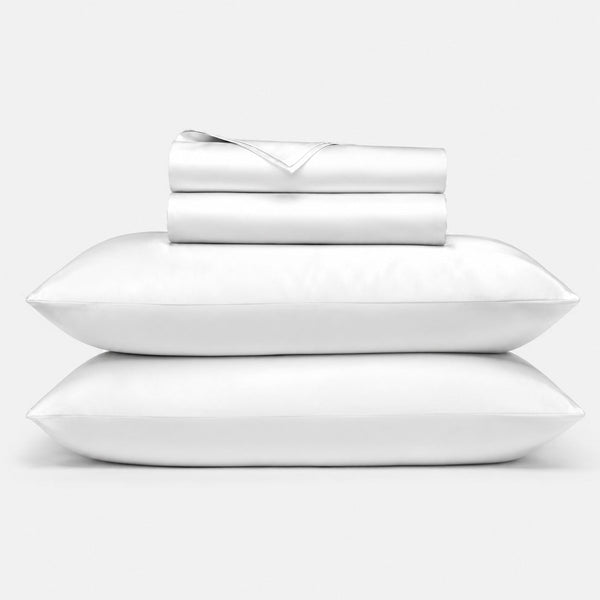
The most-asked bamboo question on Google isn't about softness or cooling. It's “what's the downside?” — which tells you how these sheets are usually sold: all halo, no fine print. We sell them, so here's the fine print first.
Yes, good bamboo sheets are genuinely good — cooler, softer, and kinder to skin than similarly priced cotton. The real downsides: they need cool-water care, they wrinkle if abandoned in the dryer, silky drape isn't for crisp-sheet lovers, and cheap “bamboo blend” products give the category a bad name.
The downsides, unburied.
What we'd warn a friend about
- Care rules are real. Hot washes, high dryer heat, and fabric softener will age them fast. If your laundry style is “everything on hot,” buy cotton. (The full routine.)
- They wrinkle when neglected — left in a dryer ball overnight, they'll show it. On the bed, wrinkles relax; purists who iron will iron.
- The feel is a taste. Silky and drapey. If your dream bed is a crisp hotel percale, bamboo will feel too fluid.
- Price is above microfiber and commodity cotton. Less of an issue at our price — we've published what a $129.95 set actually costs us — but real at $250 brand pricing.
- Label games plague the category. “Bamboo blend” with 30% viscose behaves like the 70% it doesn't advertise. If the tag doesn't say 100% rayon/viscose from bamboo, it isn't the product this article is about.
- “Eco” needs honesty. Great crop, chemical process — the nuance is here.
What bamboo does that cotton can't.
The case for
- Runs cooler. Breathable weave + moisture-wicking fiber = no clammy 3 a.m. envelope. (Mechanism here.)
- Softer per dollar. A 300-count bamboo sateen outfeels cotton at twice the price — the fiber is smooth by construction, not by inflation of thread counts.
- Kind to skin and hair. Round, low-friction fiber; stays drier, so dust mites and dampness irritation lose their habitat.
- Resists pilling. Long filaments, few broken ends — washed cool, the face stays smooth for years.
- Drapes instead of tents. The fabric settles onto you — the “sleeping in a cloud” line customers keep writing in reviews.
Bamboo's cons live in the laundry room. Its pros live in the bed. Decide which room you care about more.
The whole article in two sentencesSo — should you buy them?
Buy bamboo if: you sleep hot or sweaty, share a bed with a furnace, are navigating menopause, have sensitive skin, or love a soft, weightless drape. Skip it if: you're devoted to crisp percale, you wash everything hot, or you sleep cold — flannel and heavy cotton are your friends and there's no shame in it. Still torn between fibers? The head-to-heads: bamboo vs cotton and bamboo vs eucalyptus vs linen.
Why trust a seller's pros and cons?
Fair question. Our answer: the return label. Every downside we hide from you before the sale comes back to us as a refund after it. Being straight about softener, wrinkles, and percale-people is cheaper than pretending — honesty is our margin strategy, not our marketing one.
What “bamboo” means on a tag.
Almost every bamboo bed sheet sold in the US is rayon. The plant is pulped, dissolved, and extruded as a regenerated cellulose fibre, which is why the only fibre name that is legally correct is 100% rayon (viscose) from bamboo. This is not a technicality invented by pedants: the Federal Trade Commission has spent fifteen years fining retailers who print “bamboo fabric” on a rayon product. In 2013 Amazon, Macy's, Sears and Leon Max paid $1.26 million in combined penalties under the Textile Rules, after the FTC had already warned 78 retailers to stop. So when a listing is coy about the material, that vagueness is usually deliberate — and it is the single most useful quality signal a shopper gets for free.
The four materials sold as “bamboo”
- Viscose (rayon) from bamboo. The common one, and what our bedding is. Round, smooth fibre; silky drape; the softness and cooling most people are looking for when they search for bamboo sheets.
- Bamboo lyocell. Same cellulose, made in a closed-loop solvent process that recaptures most of the chemistry. Crisper hand, higher price, and far rarer in bamboo than in eucalyptus — most lyocell bedding on the market is not bamboo at all.
- Bamboo modal. A viscose variant stretched further during spinning: thinner, lighter, stretchier. Common in knit sheets and pyjamas, unusual in woven bed sheet sets.
- Bamboo linen. Mechanically processed from the stalk with no dissolving chemistry, so it is the most natural option on paper — and much rougher, much more prone to wrinkling, and almost never sold as bedding.
Then there are blends. A “bamboo blend” sheet is usually a minority of viscose carried by polyester or cotton, and it behaves like whatever the majority fibre is: a 40/60 bamboo-poly sheet is a polyester sheet with a marketing budget. A bamboo-cotton blend is an honest, cheaper, slightly warmer product — just not the one people mean when they ask whether bamboo sheets are good. If the tag lists no percentages at all, assume the worst.
Sustainable plant, industrial process.
The crop deserves its reputation. Bamboo regrows from its own root system in a few years, needs no replanting, and is grown commercially without pesticide, fertiliser or irrigation — which is a genuinely better environment story than conventional cotton, a thirsty crop that accounts for a large share of global insecticide use. The caveat sits downstream. Turning that pulp into viscose requires caustic soda and carbon disulphide, and how much of it a mill captures and recycles varies enormously between factories. That makes “is bamboo sustainable” a question about a specific mill, not about the plant, and any brand that answers it by talking only about how fast bamboo grows is answering a different question.
The practical proxy is certification. OEKO-TEX STANDARD 100 tests the finished fabric — every thread, every dye, every button — against a list of more than 1,000 harmful substances, including formaldehyde, banned azo dyes, heavy metals and residual pesticide, at limits stricter than the law requires. It does not certify the whole supply chain, and we would rather say that plainly than let the logo do more work than it has earned. Our bamboo bedding carries it; that is a statement about what does not remain in the fabric touching your skin, and nothing more.
One more claim worth retiring: “naturally antibacterial”. Whatever the standing plant does, it does not survive being dissolved into rayon, and in 2009 the FTC charged sellers with “bamboo-zling” consumers over exactly these antimicrobial and eco claims. What is fair to say is narrower and still useful: the fabric is smooth, low-friction, and moves moisture off the skin instead of holding it, which is why sleepers with sensitive skin and dust-mite allergy sensitivities tend to prefer it. That is a comfort property, not a treatment.
How to judge quality in sixty seconds.
What we would check on any listing, ours included
- The fibre name. “100% rayon (viscose) from bamboo”, with no percentages hidden. Anything vaguer is a blend or a bluff.
- The thread count, sceptically. Around 300 is the sweet spot for a bamboo sateen. Numbers above roughly 600 are marketing fiction — reached by counting multi-ply yarns twice — and a durable sheet is a function of fibre quality, not arithmetic.
- The weave. Sateen gives the cool-to-touch silky drape people buy bamboo for; percale is crisper and much less common in this material. Neither is better; they are different tastes, the same way cotton sheets split into percale and sateen camps.
- Pocket depth and corner straps. Measure your mattress with the topper on. Ours are cut for 17-inch pockets and include straps, because a sheet that lifts at 4 a.m. is not comfort, whatever the fabric.
- A test-based certification. OEKO-TEX STANDARD 100 or equivalent. It takes ten seconds to check and it is the only claim on most listings that someone else verified.
A note on fit before you buy: our bamboo is made in Queen, King, Cal King, Split King and Split Top King only, so if you sleep on a Twin XL or a Full this is not the range for you. Shipping is free over $75, and every size in the line clears that on its own. Care is the other half of the value equation — washed cool and dried low, a good set stays smooth for years, and the material takes longer to look tired than a comparable cotton sheet because there are fewer short broken fibre ends to work loose.
Questions we get every week.
What is bamboo viscose actually made of?
It starts as a natural plant and ends as a manufactured fibre, which is why both halves of the name matter. The bamboo is the raw material; the viscose is the process. A brand that prints only one of those two words on the label is telling you something about how it markets, and possibly about what else is in the fabric.
Are bamboo sheets hypoallergenic?
Dust mites thrive in damp bedding, so a sheet that wicks moisture instead of holding it makes for a less hospitable bed, and a low-friction surface is gentler on skin that reacts to coarse cotton. That is the honest version of the hypoallergenic claim. If you have a diagnosed allergy or a skin condition, treat sheets as comfort, not as care, and talk to your doctor.
Are bamboo sheets bad for the environment?
Fast regrowth, no pesticide, no irrigation on one side; caustic soda and solvent recovery rates on the other. A bamboo sheet from a closed-loop mill and a bamboo sheet from a careless one arrive in the same shopping cart looking identical, which is exactly why the eco-friendly framing on most listings is worth so little.
How long do bamboo sheets last?
Long filaments and a smooth surface mean less pilling over time than a short-staple cotton sheet, but the material is less forgiving of abuse. High dryer heat and softener build-up are the two things that turn a soft sheet scratchy, and both are entirely within your control.
Are bamboo sheets good for hot sleepers?
Breathability is only half of it. Cotton absorbs sweat and holds it against you; bamboo viscose moves it to the surface where it evaporates, which is why the fabric keeps feeling cool rather than damp. If your complaint is waking up clammy rather than waking up hot, this is the fibre to try.
The pros, in fabric form
100% rayon (viscose) from bamboo · OEKO-TEX · 17" pockets + straps · from $129.95 · judge us in the reviews.