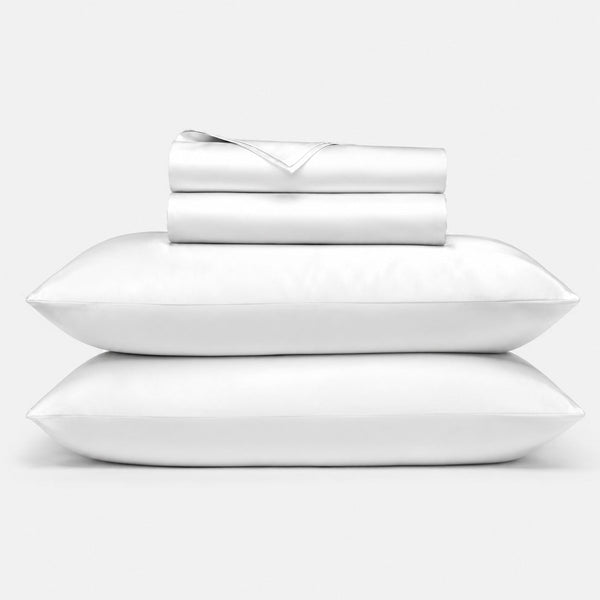
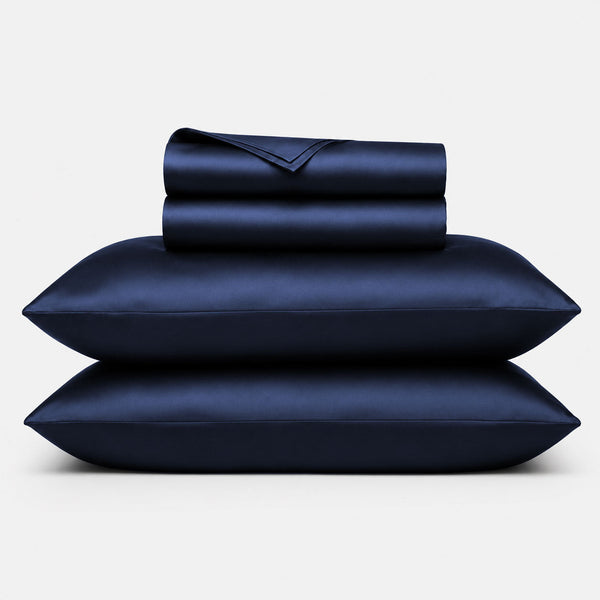
We sell bamboo sheets, so let's disarm that upfront: cotton is a great fiber, some sleepers should absolutely buy it, and this page will tell you if you're one of them. Deal? Here's the comparison the way we'd give it across a kitchen table.
Bamboo wins on cooling, moisture-wicking, softness-per-dollar, and wrinkle behavior. Cotton wins on crispness, care simplicity, and tradition. Hot sleepers and night-sweaters should buy bamboo; crisp-percale purists and hot-wash households should buy cotton.
Round and smooth vs flat and twisted.
Cotton fibers are flat ribbons with a natural twist — that geometry gives percale its crisp hand and its faint texture against skin. Bamboo viscose fibers are extruded: round, uniform, smooth. That's why the same sateen weave feels silkier in bamboo than in cotton, and why bamboo drapes onto the body while cotton tents over it. That uniformity is also why bamboo fiber typically feels softer straight out of the bag, while a good cotton sheet needs a few washes to break in. The weave is a separate variable from the fiber, and we take that apart in percale vs sateen.
Neither is “better fiber” in the abstract. They're different tools: crisp architecture vs fluid drape. Which material is right for you depends less on which fabric wins on paper and more on what your body actually does at night.
Who stays cooler?
Bamboo, and it isn't close for warm sleepers. The viscose fiber wicks moisture along its length and releases it — cotton absorbs up to a quarter of its weight in water and holds it. A damp cotton sheet at 3 a.m. is an insulator wrapped around a humid body. The mechanism is unpacked in Do Bamboo Sheets Actually Keep You Cool?, but the short version: bamboo doesn't refrigerate you, it just stops trapping your own heat and sweat.
The honest flip side: if you sleep cold, cotton's insulation is a feature. Flannel — brushed cotton — exists precisely because of it. Breathability is not the same thing as being cold, either: a breathable, moisture-wicking sheet moves heat and damp away from you rather than holding one fixed temperature, which is why bamboo suits people whose comfort swings across the night.
Cotton absorbs your night and keeps it. Bamboo lets it evaporate. Everything else is preference.
The one-sentence versionThe whole scorecard, no cherry-picking.
| Bamboo viscose | Cotton | |
|---|---|---|
| Cooling & wicking | Wins. Breathes and dries fast | Absorbs and holds moisture |
| Feel | Silky, drapey, “buttery” | Wins for crisp lovers. Structured, matte |
| Softness per dollar | Wins. Soft at 300 count | Comparable softness costs Egyptian-cotton money |
| Care | Cool wash, low dry, no softener | Wins. Tolerates hot washes and abuse |
| Wrinkles | Wins. Relaxes on the bed | Percale wrinkles proudly; needs ironing for the crisp look |
| Durability | 4–6 yrs washed cool; resists pilling | Long-staple cotton lasts similarly; short-staple pills |
| Sensitive skin | Wins. Low friction, stays drier | Fine, unless mites/damp are the trigger |
| Eco | Great crop, chemical process (honest breakdown) | Thirsty, pesticide-heavy unless organic |
| Thread count | 300–400 is the useful range; the fiber does the work | Higher counts buy smoothness — up to a point |
| Water use | Wins at the field. Grows rain-fed, no replanting | Among the thirstiest crops; organic avoids pesticides but still requires irrigation |
Try the bamboo side of the argument
100% rayon (viscose) from bamboo · OEKO-TEX · 17" pockets, corner straps · from $129.95.
The questions people also ask.
Is bamboo or cotton better for sheets?
Which is healthier — cotton or bamboo?
Is “bamboo cotton” better than 100% cotton?
Do bamboo sheets feel like Egyptian cotton?
What is the downside to bamboo sheets?
The care rule is the one that catches people out. Hot water and high dryer heat weaken the fiber and set the wrinkles, and fabric softener coats it and kills the wicking. Wash cool, tumble low, skip the softener: with proper care a set typically lasts four to six years. Ignore all three and you might ruin a good set in a season — long-staple cotton is simply more durable under that kind of abuse.
The second downside is a shopping problem more than a fabric problem. Sheets sold as bamboo at bargain-bin prices are commonly rayon padded out with polyester, and polyester is the part that pills and traps heat. Read the fiber content, not the marketing — ours says 100% rayon (viscose) from bamboo, which is also what keeps it low-friction against sensitive skin.
The third is honest chemistry: bamboo viscose is dissolved and extruded in a chemical process, not simply spun the way a natural fiber like cotton is. That is a real difference, however you weigh it. OEKO-TEX certification tests the finished fabric for residues, which is the part that ever touches you. Those are the pros and cons in full.
Does thread count matter for bamboo sheets?
Thread count measures threads per square inch, and there is a physical ceiling on how many will fit. Mills get past that ceiling by counting each ply of a multi-ply yarn separately, which is how a “1500 thread count” set is often a 300-count fabric with creative arithmetic. Above about 600 the number stops describing quality and starts describing the marketing department.
What actually drives feel is fiber quality and weave. In cotton, long-staple fiber in a sateen weave feels smooth, while short-staple in a coarse weave feels dry and scratchy at any count. Bamboo starts out round and uniform, so a 300-count bamboo sateen is typically softer than a 600-count cotton one. Use thread count to sanity-check a claim, never to rank two sets. The other number on the label, GSM, measures the fabric's weight rather than its density — more useful for predicting drape, and gamed in its own particular way.
Which type of cotton should you compare bamboo against — Egyptian, Pima or upland?
“Cotton” on a label covers three very different materials. In cheap cotton sheets the cotton is upland — the common commodity crop, short fibers, more exposed ends, more pilling over time. Pima (grown in the US and sold as Supima) and Egyptian cotton are long-staple: fewer fiber ends, a smoother hand, better durability, and it costs accordingly.
So the right comparison depends on the option you are actually choosing between. Against a budget upland set, bamboo wins on softness, drape and cooling comfortably. Against a well-made Pima percale you are choosing a feel rather than a quality tier — silky and cool versus crisp and dry — and short-staple cotton, the one that is prone to pilling, is not really in that conversation. Both sit in the luxury tier, and neither is the wrong answer.