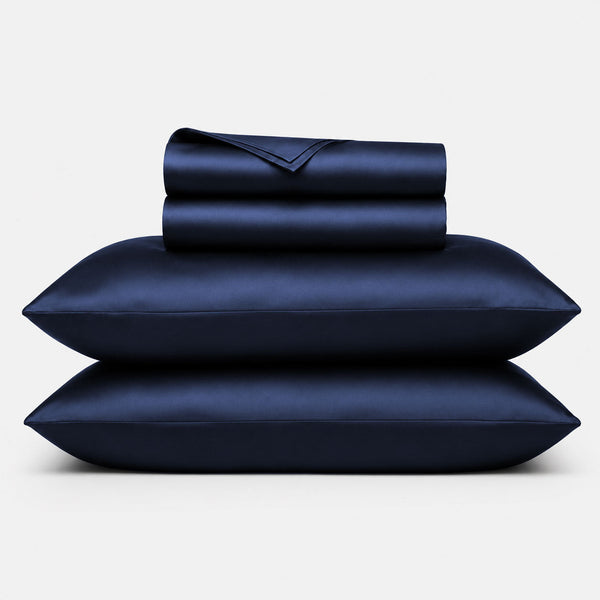
There is a purchase order sitting on our desk this week for 3,114 sheet sets. It has not gone out yet — two lines still need checking — but the numbers on it are final, and between them they answer a question our own product page cannot honestly answer: where bamboo sheets are actually made. So here is the document, and here is where our knowledge of it stops.
Our next order is 3,114 sets at $83,860 landed, about $26.93 a set, arriving roughly 150 days after we sign — 90 days of manufacturing and 60 at sea. Where bamboo sheets are made is really three questions, and the one that matters most is where the plant is dissolved into viscose fibre, which happens in a small number of very large chemical plants in Asia and Europe. We can prove our fabric's certification. We cannot yet prove which forest the pulp came from, and we will not pretend otherwise.
Three thousand sets and one wire transfer.
The order covers 32 SKUs across five sizes: 1,147 Queen, 739 Split Top King, 455 King, 439 Split King, 334 Cal King. Landed cost is $83,860.02, which works out to $26.93 a set — the same blended figure we published when we took apart what a $129.95 sheet set costs us. Packed, it is somewhere between 25 and 47 cubic metres depending on how tightly the sets are compressed, which is the difference between comfortably filling one container and awkwardly not filling two.
Terms are 30/70. About $25,158 leaves this month, against a product none of us has touched. The remaining $58,702 is due when the goods ship, around the first of November. Three hundred and fifty of the sets will fly rather than sail, at roughly $3,500 extra, because those specific sizes and colours will run out before the sea shipment lands and an empty page sells nothing. All in, the order is about $87,360, and it is the single largest cheque this business writes.
Made in is three questions.
Bamboo bedding is not woven from bamboo the way linen is spun from flax. The plant is chipped, cooked into cellulose pulp, dissolved in chemicals and pushed through a spinneret as filament. That is the viscose process, and it is chemistry rather than weaving — a manufacturing step, not an agricultural one. Which means the question splits into three: where the bamboo is grown, where the pulp is dissolved and spun into viscose fibre, and where the finished fabric is woven, dyed, cut and sewn. Brands answer whichever of the three flatters them most, and almost none of them tell you which one they answered.
The middle step is the concentrated one. Viscose is the largest man-made cellulosic fibre in the world by a wide margin, according to Textile Exchange's Materials Market Report, and it is produced by a small number of enormous plants rather than by a long tail of small mills. The environmental group Canopy rates essentially that entire industry every year in its Hot Button Report; in the 2024 edition the three top-scoring producers were Aditya Birla in India, Lenzing in Austria and Tangshan Sanyou in China. That is the level at which the origin question has a real answer, and it sits upstream of nearly every bedding brand on the market, ours included.
The third step — weaving, dyeing, cutting, sewing — is the one most labels are describing, and the one a brand can genuinely choose. It is also the cheapest step to move, which makes it a poor guide to anything. A textile product can change its stated country of manufacture without a single molecule of the material changing, and the making of the fibre itself carries on exactly where it was.
A label tells you where the fabric was sewn. It rarely tells you where the fibre was made, and it never tells you where the tree grew.
The gap this series exists to closeWhy ours says rayon.
Because the fibre is dissolved and re-extruded, it is legally no longer bamboo. Under the US Textile Rules — 16 CFR Part 303, with a plain-language summary on the FTC's Bamboo Textiles page — only mechanically processed bamboo may be called bamboo fibre. Everything else has to be labelled as rayon or viscose made from bamboo. Ours reads 100% rayon (viscose) from bamboo for exactly that reason. A set advertised as 100% bamboo is not a better product; it is a worse label.
This is enforced, and expensively. On 8 April 2022 the FTC took action against two national retailers, seeking civil penalties of $2.5 million against Kohl's and $3 million against Walmart — $5.5 million in total, its largest ever in this area — for marketing rayon textiles as bamboo, and separately for the eco claims attached to them, on the FTC's stated position that converting bamboo into rayon uses toxic chemicals and produces hazardous pollutants.
The same logic applies to the word organic. Bamboo is a genuinely good crop: it grows fast, regrows from its own root system without replanting, and is typically raised without pesticides or irrigation, unlike cotton, which is among the thirstiest fibres in the textile industry. All of that is true at the field, and none of it survives the chemistry intact. Once the plant has been reduced to cellulose and put in solution, an organic certificate covering the stalk tells you very little about the material in your hands. The sustainability of viscose is won or lost in the pulp mill's chemical recovery systems, not in the plantation.
Which makes the sustainable-versus-eco-friendly argument in this category harder than either side admits. On the growing side bamboo is a strong choice: little water, no pesticide programme, no annual replanting, a natural crop that regenerates on its own. On the production side it is heavy industry, and the harmful chemicals used to make viscose are only as contained as the plant containing them. A closed-loop mill recovers and reuses most of them; a badly run one puts them in a river. Neither the fibre name nor an eco-friendly graphic on a packaging insert tells you which kind of mill made your sheets. Canopy's ranking is the closest thing to a public scorecard, and it is worth more than any brand's own claim, including ours.
The honest edge of our own paperwork.
We can document that our fabric carries OEKO-TEX Standard 100 certification, which tests finished textiles for harmful substances — the part that ever touches your skin. We can document the mill, the SKUs, the unit costs and the payment terms, because we sign them, and we have published them here.
What we cannot yet document is the forest. A purchase order proves what we buy; it does not prove the chain behind what we buy. Pulp changes hands more than once before it reaches a weaving mill, and tracing a finished bolt of fabric back to a specific stand of trees is the hard, largely unsolved problem of this industry — which is precisely why Canopy's ranking exists. We have not done that work yet. When we do, it will appear in this series with the paperwork attached, and if the answer is uncomfortable we will print it anyway.
Worth saying plainly, since this is the transparency series: rayon has an ugly environmental history and it is not ancient. The last large American rayon plant, Avtex Fibers in Front Royal, Virginia, made fibre from 1940 until it closed in 1989 after thousands of state environmental violations, and the 440-acre site has been on the EPA's Superfund list since 1986. That is the honest reason there is no American-made bamboo viscose to buy. The process improved enormously; it did not become clean by magic, and the modern argument for it rests on closed-loop chemical recovery being done properly, somewhere you cannot see.
Why your size is out of stock.
We plan on a 150-day lead time: roughly 90 days of manufacturing and 60 days from the factory gate to our warehouse in Houston. An order signed at the end of August therefore becomes sellable inventory around the turn of the year, and the next order after it goes out in early January and lands in June. Everything you can buy from us today was guessed at, in quantity and in colour, about five months ago.
| Stage | Elapsed | What is happening |
|---|---|---|
| Deposit | Day 0 | 30% wired, about $25,158, against nothing that exists yet |
| Manufacturing | Day 0–90 | Fibre, weaving, dyeing, cutting, sewing, packing |
| Balance due | ~Day 90 | The remaining $58,702, payable at shipment |
| Ocean freight | Day 90–150 | Port, vessel, port, customs, drayage to Houston |
| Air exception | ~Day 95 | 350 sets flown at about $3,500 to cover the gap |
| On the shelf | ~Day 150 | Around the turn of the year, five months after the guess |
The guessing is worse than it sounds. Our reorder tool reads the last 70 days of sales, and one line on this order asks for 250 sets of Queen in White against zero units sold. Zero, in that window, because we had zero on hand for all of it — the size and colour were simply absent from the site. A stockout looks exactly like an absence of demand in the data, and no amount of quality in the forecasting model fixes a number that was never allowed to happen. So we overrode it and ordered 250 anyway, on the judgement that White is the colour people search for. If that judgement is wrong, it is $6,732 wrong, and you will read about it here.
The opposite case is on the same page: Queen in Cream sold 7 sets with 74 sitting in the warehouse, so it gets 34. Same product, same fibre, same quality, wildly different order — the difference is entirely inventory position, not preference.
The sets this order is for
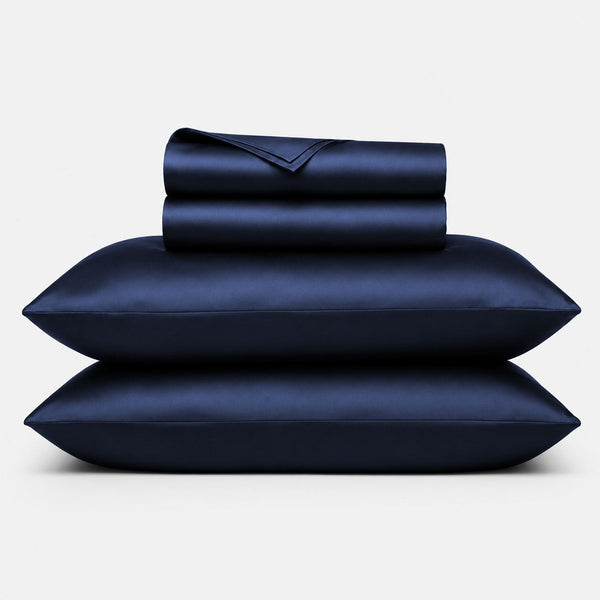
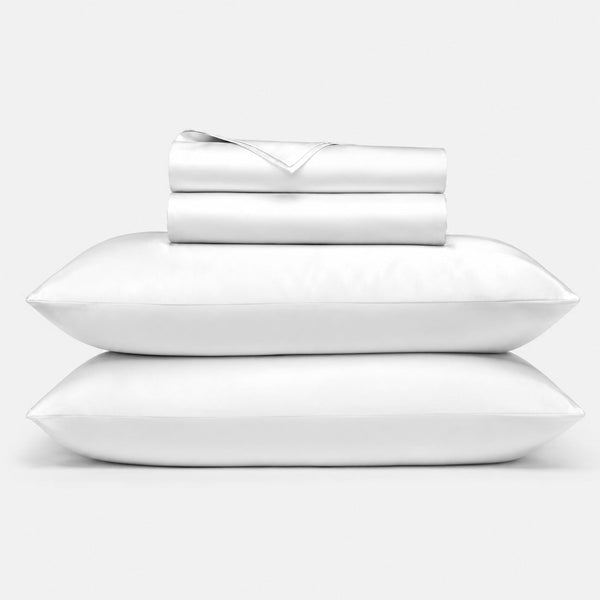
100% rayon (viscose) from bamboo · OEKO-TEX Standard 100 · 17-inch pockets · Queen, King and Cal King $129.95, Split King $139.95, Split Top King $169.95 · free shipping over $75.
The questions people also ask.
Where are bamboo sheets made?
This matters when you are comparing two sets. Two brands can share a fibre producer, or even a weaving mill, and describe their origins completely differently without either of them lying. If origin genuinely matters to you, ask which of the three steps a brand is describing — the answer is far more revealing than the country itself.
Are any bamboo sheets made in the USA?
So a made-in-USA claim on bamboo bedding is describing the sewing, not the material. That is a real distinction and worth paying for if domestic manufacturing matters to you, but it does not change where the fibre came from or how it was made.
Is bamboo fabric made with chemicals?
The chemicals are a process input, not an ingredient in the finished sheet, and OEKO-TEX Standard 100 testing exists to verify that the fabric you sleep on carries no harmful residues. Both things are true at once, and any brand that tells you only the second one is selling you a story. We take the whole question apart in what is bamboo viscose, and is it safe.
Why does my label say rayon or viscose instead of bamboo?
Are organic bamboo sheets really organic?
How long does it take to restock a sheet size?
It also explains a pattern you may have noticed across the whole bedding category: colours quietly disappear and reappear seasonally. Nobody discontinued them. Somebody's forecast was five months old.
Are bamboo sheets eco-friendly?
So the honest answer is that bamboo fabric is neither the eco-friendly miracle it is marketed as nor a disaster. It is a good crop put through an industrial process whose environmental performance varies enormously by producer. If sustainability is what you are buying on, ignore the word natural on the packaging and look up the fibre producer's rating instead.
Does where sheets are made affect how they feel?
What actually changes how a set sleeps is fibre content, weave and finishing — and whether the bamboo fabric is pure viscose or cut with polyester, which is the real quality tell in this category. Cheap blends are the ones that pill and trap heat against your skin. We compare the natural fibres side by side in bamboo vs cotton, and the rest of the buying questions live in the bamboo hub.