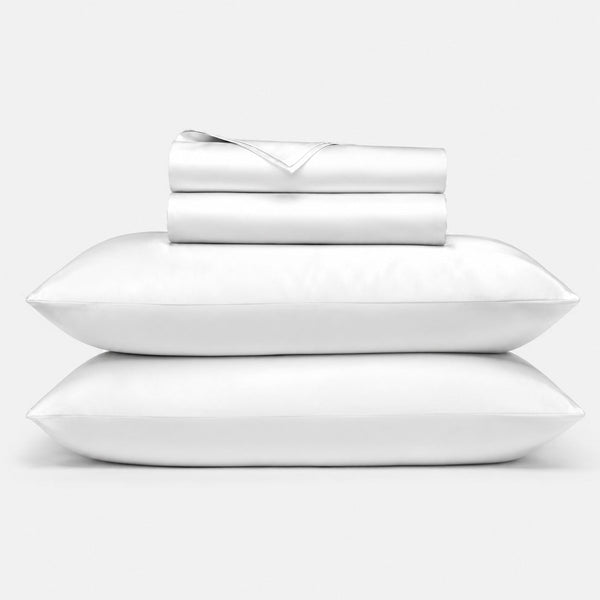
We sell these sheets, which makes what follows either brave or stupid depending on how the quarter goes. This is the actual receipt for one Queen set of our bamboo sheets, every line of it, including the line that turns out to be bigger than the sheets.
A Queen set lists at $129.95, but the average customer paid $100.25. The sheets cost us $26.93 landed and $9.91 to deliver, while advertising cost $37.22 - more than the product itself. What is left is $26.18, and that is before anyone is paid a salary.
Almost nobody pays $129.95.
Between May 14 and July 22 of this year we sold 53 Queen sets. Revenue after discounts: $5,313.05. That works out to $100.25 a set, or 22.9% below the number printed on the product page.
This was not one big sale. It is that there is nearly always something running - a bundle, a holiday code, a buy-two-get-one. The list price functions less as a price than as a ceiling, and if you have ever wondered why bedding is permanently on sale, that is the mechanism. Every figure below is measured against the $100.25, because that is the money that actually arrived.
The sheets themselves cost $26.93.
That is landed cost: everything needed to have one folded set sitting on a shelf in our warehouse. Roughly $1.80 of it is ocean freight, which leaves about $25.13 for the mill - fiber, spinning, weaving, dyeing, cutting, the 17-inch elasticated corners, the corner straps, the packaging.
One honest caveat: $26.93 is a blended number, a single landed cost carried across all five sizes. A Split Top King uses considerably more fabric than a Queen, so in this model the Queen is quietly subsidising it. We could split the figure by size. We have not yet, and you should know that before you quote us.
What that $25 is not buying is a thread count worth bragging about. Anything much above 600 is marketing fiction - the count gets inflated by counting plies rather than threads. What it does buy is a fiber that has to be labelled honestly: ours is 100% rayon (viscose) from bamboo, because the FTC recognises 28 generic fiber names and bamboo is not one of them. Sheets sold as 100% bamboo are not a better product, just a worse label. The rule is 16 CFR Part 303, and the FTC keeps a plain-language page on it at Bamboo Textiles.
Getting it to your door: $9.91.
A single-set shipping label averages $7.95 across a 99-label sample of our own July invoices. Singles are bimodal rather than tidy - a light USPS package can go for about $5.97, while a heavier or split shipment runs $12 to $16 - so the average is doing real work there. Add $1 for the box and $0.30 in fixed payment fees, and every order carries $9.25 before a percentage is taken. Card processing takes 2.4% on top.
Spread across 53 sets sold in 43 orders, that comes to $9.91 a set. Free shipping over $75 means a Queen set always ships free, which is a way of saying we pay the label. Free shipping is a marketing expense wearing a logistics costume, and it belongs in this column all the same.
| Line | Per Queen set | What it is |
|---|---|---|
| List price | $129.95 | The ceiling, not the price |
| Actually paid | $100.25 | Average across 53 sets, after discounts |
| Landed cost | - $26.93 | Mill plus about $1.80 ocean freight; blended across sizes |
| Label, box, fee | - $7.51 | $9.25 an order, shared when someone buys two |
| Card processing | - $2.41 | 2.4% of the order |
| Advertising | - $37.22 | $23.64 Google, $13.59 Meta and email |
| Left over | $26.18 | Contribution - not profit. See chapter 05 |
Advertising cost more than the sheets did.
$37.22 a set. Of that, $23.64 is item-level Google Ads spend inside the Queen campaign - a real number, not an allocation - and $13.59 is this size share of Meta and email. Put differently: the two ad platforms took more per set than the mill, the freight, the box, the label and the card processor combined, which come to $36.85.
That is the part of the price nobody puts on a spec sheet, and it is why a modern bedding company is best understood as an advertising business with a textile hobby. The number is not fixed, either. Roughly a quarter of our bamboo orders arrive through Google free listings at no ad cost at all, and those orders quietly subsidise the ones we had to buy.
The sheets cost us $26.93. Finding you cost $37.22. That is the whole industry in two numbers.
The line we would rather not print$26.18, and it is not profit.
That is 20.2% of the sticker and 26.1% of what was actually paid. It is contribution, which means it arrives before salaries, rent, software, accounting, customer service and returns - and before the cost of committing tens of thousands of dollars to an inventory order roughly five months ahead of the first set of it selling. By the time all of that is subtracted, the number that reaches the bottom line is materially smaller.
Averages also hide things. A Split Top King clears about $63.60 a set while a Cal King clears $16.02, because the ad cost is similar and the price is not. Some combinations lose outright: we sold three King sets in the Shore colourway for $345.87 in that window while Google Ads spent $347.95 finding those three buyers. We have not dropped the colour, because people search for it and the bidding is fixable, but the honest description of those three orders is that they cost us money.
So that is the receipt. If you want the fiber argument rather than the money one, we made the case both ways in bamboo vs cotton, and the broader questions live in Bed Sheets 101. But when someone tells you a sheet set is worth $400, the interesting question is not the fabric. It is which line of their ledger the other $300 is paying for.
The set this ledger is about
100% rayon (viscose) from bamboo · 17-inch pockets · free shipping over $75 · from $129.95.
The questions people also ask.
Why are sheets so expensive?
How much does it actually cost to make a set of sheets?
Why is bedding always on sale?
Does a cheaper sheet set mean worse sheets?
We cannot see anyone else the way we can see ourselves - this is our cost stack, not theirs. But the fixed costs of shipping a box and buying a click do not shrink because the sticker does, which is the part of a cheap price that has to give somewhere.