There is a number that circulates about bedrooms — sixty-five degrees — repeated with a confidence its evidence base does not quite earn. That doesn't make it wrong. It makes it a convention rather than a finding, which is worth knowing before you spend a summer arguing with a thermostat. The underlying science is real; it's just about something slightly different from the number. Not how cold the room is, but how easily your body can get rid of heat.
Start at 65 °F (18 °C) and adjust in 2-degree steps, judging by how fast you fall asleep — but hold the number loosely, because a 2023 study of older adults in their own homes found sleep was most efficient between 68 and 77 °F. The room isn't really the variable; the microclimate under your covers is, and the target is a cool head with warm hands and feet. The highest-return item here isn't the thermostat at all — it's a warm shower one to two hours before bed.
Falling asleep is a heat-dumping problem.
Your core body temperature falls by roughly a degree Celsius around sleep onset. That drop isn't a side effect of sleeping — it's part of the machinery that starts sleep. And to shed that heat, your body opens the blood vessels in the places built for it: hands, feet, face.
The cleanest demonstration is still Kräuchi, Cajochen, Werth and Wirz-Justice in Nature, 1999, under the wonderfully blunt title “Warm feet promote the rapid onset of sleep.” They tracked the gap between distal skin temperature (hands and feet) and proximal skin temperature (trunk). That gradient turned out to be the strongest predictor of how quickly people fell asleep — stronger than the other physiological measures they collected, melatonin included.
Read it the right way round. Warm feet don't sedate you; warm feet are what heat loss looks like from the outside. A hot room stalls the process because there's nowhere for the heat to go. Cold feet stall it too, for the opposite reason: the vessels clamp shut and the radiator switches off. Both end in the same place, staring at the ceiling.
The figure nobody can quite source.
The 60–67 °F range is everywhere, usually credited to the National Sleep Foundation, and almost never footnoted to a trial. We went looking. It's a reasonable summary of a body of work — not a result.
What is well evidenced is the direction, and especially the harm side of it. Okamoto-Mizuno and Mizuno's 2012 review in the Journal of Physiological Anthropology is the standard reference: in realistic conditions — with bedding and nightclothes — heat exposure increases wakefulness and cuts both slow-wave and REM sleep. Humid heat is harder on sleep than dry heat, because sweating stops working as a cooling strategy once the air is saturated.
Obradovich and colleagues, Science Advances, 2017, matched 765,000 US survey responses to nighttime temperatures: a 1 °C anomalous rise produced three extra nights of insufficient sleep per 100 people per month, concentrated among lower-income and older respondents. Minor and colleagues, One Earth, 2022, went bigger — 7 million nights of wristband data from 47,628 people across 68 countries — and found nights above 30 °C (86 °F) cost about 14 minutes of sleep, lost mostly at the front end, through delayed onset.
Then the part the tidy version leaves out. Baniassadi and colleagues, Science of the Total Environment, 2023, put sensors in the homes of 50 older adults and collected nearly 11,000 person-nights. Sleep efficiency peaked between 20 and 25 °C — 68 to 77 °F — and fell 5 to 10% as rooms warmed from 25 to 30 °C. The authors also flagged substantial variation between individuals.
That doesn't overturn the cool-room advice; it qualifies who it's for. Young adults in a lab and seventy-somethings in their own bedrooms are not the same thermoregulatory animal, and neither is you-in-January versus you-in-August. Treat 65 °F as where to begin, not where to end.
You are not trying to be cold. You are trying to dump heat — a different problem, and one solved mostly at your hands and feet.
The one-sentence versionCool room, warm skin.
This is the distinction that fixes most setups, and the one the internet consistently flattens.
Raymann, Swaab and Van Someren, Brain, 2008, used a thermosuit to nudge skin temperature by less than 0.4 °C — too small to move core temperature, too small for subjects to reliably notice. Nocturnal wakefulness fell and sleep shifted toward deeper stages. The effect was largest in older adults and in people with insomnia: the two groups most likely to be told to just turn the air conditioning up.
So “sleep cool” is half an instruction. Cool the air. Keep the skin comfortable. A cold room that leaves you with numb feet under a heavy duvet is a worse setup than a mild room with breathable layers, however much better the thermostat reads.
What to actually do tonight.
| Step | What to do, and why |
|---|---|
| Set a baseline | 65 °F for a week. Then move 2 degrees, either direction, for another week. Judge on how fast you fall asleep and how often you surface at 3 a.m. — not on how the room feels at bedtime, which is a poor predictor. |
| Warm shower first | One to two hours before bed. Haghayegh and colleagues' 2019 meta-analysis in Sleep Medicine Reviews: water at 40–42.5 °C (104–109 °F), as little as ten minutes, shortened sleep onset by roughly a third. Warm the skin, open the vessels, and heat leaves faster once you're out. |
| Socks, if feet run cold | Same mechanism, no bathtub required. The least glamorous item here and one of the most effective. |
| Layers, not one thick thing | A top sheet plus a light blanket you can shed at 2 a.m. beats a duvet you kick off entirely and get cold under at 4. |
| Treat fabric as the real microclimate | The half-inch of air against your skin is the only temperature you experience all night. Breathable weaves move moisture; dense ones trap it — which fabrics actually move heat is the whole question. Ignore thread count above roughly 600 — past that it's a marketing number, not a construction fact. |
| Fight humidity, not just heat | If the air is damp, sweating stops cooling you. A dehumidifier, or a fan for air movement, often beats another two degrees on the thermostat. |
| Know when it isn't temperature | Waking soaked night after night, night sweats around menopause, or heat waking alongside loud snoring — those belong with your doctor, not your thermostat, and a night you simply cannot start may be a 2 p.m. coffee still working at midnight rather than a degree or two of air. A bedtime that keeps drifting later is more often a clock that never got its morning light than a room that never got cool enough. We sell sheets; we are not clinicians, and no bedding fixes sleep apnea. |
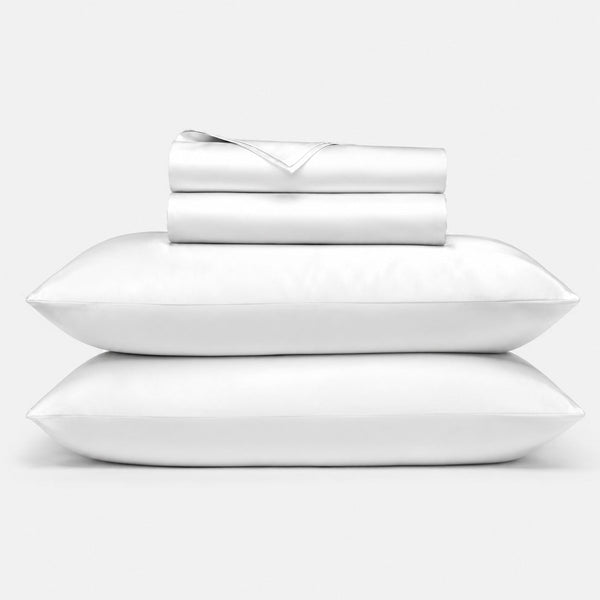
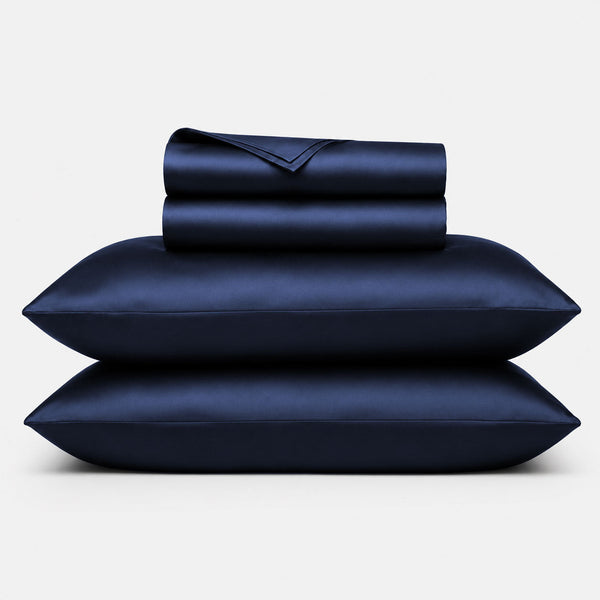
The disclosure, since this is the point where we have something to sell: we make sheets, so weigh the next paragraph accordingly. Our bamboo set is 100% rayon (viscose) from bamboo in a sateen weave, which breathes and moves moisture better than the heavy microfiber most “cooling” bedding is cut from. It is not air conditioning and we won't pretend otherwise — it's the layer between you and the room, and that layer is the one part of this protocol you're lying on all night. The trade-offs are laid out in do bamboo sheets actually keep you cool and, if you're cross-shopping fibers, bamboo versus cotton.
The layer between you and the room
100% rayon (viscose) from bamboo · sateen weave · 17-inch pockets, corner straps · from $129.95 · free shipping over $75.
The questions people also ask.
What temperature should my bedroom actually be?
The widely repeated 60–67 °F range is a convention rather than a trial result. The evidence for cooler-is-better is strongest at the harm end — heat clearly degrades sleep — while the optimum varies enough between people that only your own two-week test settles it.
Is 60 °F too cold to sleep in?
Cold extremities constrict blood vessels and shut down the body's main cooling route. If 60 °F only works for you with socks and a warm layer, that isn't a contradiction — that's the mechanism working as designed.
Do cooling sheets actually work?
Breathable weaves move moisture away faster, which matters most in humid conditions where sweat stops evaporating. That's a genuine effect, and a small one. Anyone promising a temperature drop in degrees is selling you something. More in our bamboo sheets Q&A.
Why do I wake up hot at 3 a.m.?
Your core temperature reaches its low point in the early hours, so waking hot then usually means heat isn't escaping rather than that the room got warmer, and once you are awake anyway there is a playbook for what to do at 3 a.m. If it happens most nights, or comes with drenching sweats, that's medical territory rather than bedding.