There is a specific kind of 2 a.m. that hot sleepers know well. You are not hot the way a summer afternoon is hot. You are damp, and slightly furious, and you have just flipped the pillow for the third time. Somewhere in the dark you decide the problem is the sheets, and you go looking for the best sheets for hot sleepers, and the internet hands you forty of them.
Most of that advice is organised around a false premise: that a sheet can cool you. It cannot. A sheet has no refrigeration in it. What a sheet can do is get out of the way of the heat you are already trying to lose — or fail to, and hold it against your skin along with the moisture. That distinction sounds pedantic until you use it to shop, at which point it eliminates about eighty percent of the market.
No sheet lowers your body temperature — it either lets heat and moisture escape or traps them. Sleep research points at moisture as the bigger villain: at the same air temperature, humid heat wrecks sleep worse than dry heat. Buy for breathability and fast drying, in this order of leverage: room temperature, then what is on top of you, then the sheet itself.
Your body is trying to dump heat.
Falling asleep is a thermal event. Core body temperature has to fall, and it falls because your body opens the blood vessels in your hands and feet and radiates heat out through them. In a 1999 Nature paper, Kräuchi, Cajochen, Werth and Wirz-Justice found that the gradient between distal skin (hands, feet) and proximal skin (trunk) was the best physiological predictor of how quickly people fell asleep — better than melatonin, better than core temperature itself. Warm extremities were not a sign of overheating. They were the radiator running.
Which reframes what you want from bedding. You are not trying to be cold. You are trying to keep the exhaust path open. A fabric that traps a humid film of air against your skin closes that path, and the body responds by staying awake and trying again. This is why the standard advice to hot sleepers — a cooler room, fewer layers, breathable fabric — is not three separate tips. It is one tip, stated three times.
The corollary is uncomfortable if you sell sheets, which we do: the sheet is the smallest of the three levers. It is also the cheapest and the easiest to change, which is why it gets sold to you first.
Humidity does the damage, not temperature alone.
The most useful finding in this literature is also the most ignored by product marketing. Okamoto-Mizuno and colleagues, publishing in Sleep in 1999, put volunteers through nights at 29°C and 35°C at two humidity levels, 50% and 75%. Air temperature mattered. Humidity mattered on top of it: at the same temperature, the humid condition produced more wakefulness and less slow-wave and REM sleep. Sweat that cannot evaporate is not just unpleasant, it is thermally useless — evaporation is the cooling mechanism, and saturated air switches it off.
Their later review, Okamoto-Mizuno and Mizuno (2012) in the Journal of Physiological Anthropology, adds the part that matters for shopping: the effect of heat on sleep stages depends heavily on whether bedding and clothing are used. In semi-nude subjects, cold is the bigger disruptor. In real beds, with real covers, heat is. Your bedding is not a bystander in the experiment — it is a variable in it.
Two honest caveats. These are small laboratory studies — the 1999 humidity trial ran seven healthy young men — and the field has not replicated them at scale. Treat the direction as well supported and the precise numbers as provisional. And if night sweats are new, drenching, or come with weight loss or fever, that is a medical question and not a bedding one. Talk to your doctor before you buy anything.
You are not trying to be cold. You are trying to keep the exhaust path open.
The mechanism, in one lineFix the room before you fix the fabric.
If you rank the available fixes by how much heat they actually move, the sheet lands third. This is the part of the answer that no roundup wants to lead with, because there is nothing to sell at the top of the list.
| Order | The fix | Why it outranks the one below it |
|---|---|---|
| 1 | Room temperature. Somewhere in the 60–67°F range for most adults | Sets the gradient everything else works against. A breathable sheet in a 74°F room is still a sheet in a 74°F room |
| 2 | What is on top of you. Duvet fill, weight, tog | A synthetic-filled comforter traps more heat than any fitted sheet can shed. Most hot sleepers are overheating from above and blaming below |
| 3 | The sheet. Fibre first, weave second | Real, measurable, and the cheapest of the three to change — but it modulates the problem rather than solving it |
| 4 | The mattress. Memory foam sleeps hot; a cooling mattress or a breathable topper helps | Expensive and slow to change, which is why it belongs last even though the effect is real |
| 5 | Sleepwear and timing. Lighter layers, a warm shower ninety minutes before bed | Free. The warm shower works by triggering the same distal vasodilation Kräuchi measured |
One detail that gets lost in the ranking: of everything on your bed, the fitted sheet is the layer in continuous contact with you throughout the night. A flat sheet gets kicked off, a duvet gets thrown half over. The fitted sheet stays. If you are only replacing one piece, replace that one — and if your mattress is memory foam, a breathable topper or a cooling mattress pad sits directly beneath it and compounds the effect.
Our own bedroom temperature protocol covers the first line in more detail. If you only do one thing after reading this, do that one.
What the testing press keeps landing on.
We read the seven major 2026 cooling-sheet roundups — Sleep Foundation, Forbes, CNN Underscored, Fortune, Mattress Nerd, Mattress Clarity and Cariloha — while building this piece. The pattern is hard to miss. Natural and semi-synthetic fibres dominate the discussion: bamboo viscose, sateen and percale cotton, silk, linen and TENCEL lyocell are mentioned hundreds of times across those pages. Branded polyester cooling fabrics are mentioned barely a dozen times in total, despite being the loudest category in advertising. When testers who sleep on the stuff pick favourites, they pick fibres that breathe and dry.
It is worth knowing what those tests can and cannot show. Most reviewers sleep on each set for a few nights and rate the subjective experience; the better ones add a thermal-imaging pass or a moisture-release test on a lab bench. Neither is a controlled sleep study. So when a brand claims temperature regulation, read it as a claim about how fast the fabric moves moisture and air, not as a promise that the sheet will hold you at a set temperature. Nothing in a woven textile regulates anything — it either lets the transfer happen quickly or slowly, and that is the whole of the mechanism.
Two variables decide how a sheet set behaves, and people routinely confuse them. Fibre determines how moisture moves. Weave determines how the fabric feels and how much air passes through it. Percale and sateen are weaves, not materials — you can have both in cotton and in bamboo, and we pull that apart properly in percale vs sateen.
| Material | How it handles heat and moisture | The honest catch |
|---|---|---|
| Cotton percale | Excellent. Open plain weave, crisp and matte, very breathable. The default expert pick for decades | Absorbs moisture and holds it — stays damp once you have sweated into it. Wrinkles proudly |
| Linen | Excellent. Hollow flax fibre, extremely breathable, dries fast | Expensive, coarse for the first year, and a texture people either love or return |
| Bamboo viscose | Excellent. Smooth extruded fibre, moisture-wicking, dries fast, silky rather than crisp | Needs a cool wash and low heat. It is a regenerated fibre, not a plant fibre — see below |
| TENCEL lyocell | Excellent. Similar behaviour to bamboo viscose, made in a closed-loop solvent process | Priciest of the semi-synthetics. Often sold at a premium for the trademark alone |
| Cotton sateen | Fair. Soft and lustrous, but the float weave is denser and traps more air | The most common thing sold to hot sleepers, and the weave working against the buyer |
| Polyester and microfiber | Poor. Hydrophobic and non-absorbent — sweat sits on the surface rather than moving | Cheap and durable. Cooling coatings and treatments wash out; the fibre underneath does not change |
| Silk | Fair. Smooth and light against skin, low friction | Poor at absorbing volume. Excellent for a pillowcase, oversold as a full sheet set for sweating |
One piece of vocabulary worth getting right, because the Federal Trade Commission has fined companies over it: there is no such thing as a soft bamboo fibre in a sheet. Bamboo is pulped and chemically regenerated into rayon. The legally accurate description, and the one we use, is 100% rayon (viscose) from bamboo. Anyone selling you organic bamboo fibre sheets is either misinformed or counting on you being. We go further into the process, and the safety questions around it, in what is bamboo viscose.
Thread count is the wrong number entirely.
Thread count measures threads per square inch. For hot sleepers it is close to useless, and above roughly 600 it is marketing fiction — manufacturers hit those numbers by counting multi-ply yarns as several threads each. A 1,500-count sheet is not three times better than a 500-count sheet. It is usually a denser fabric with thinner, weaker plies, which is to say: worse at letting heat out.
Higher thread count generally means a tighter, heavier fabric. If you are buying for breathability, that is the opposite of the direction you want. A 300-count percale or a 300-count bamboo sateen will nearly always sleep cooler than a 1,000-count anything. GSM — grams per square metre — is a more honest weight measure, though it too gets played with. The most reliable signal remains the plainest one: fibre first, weave second, number last.
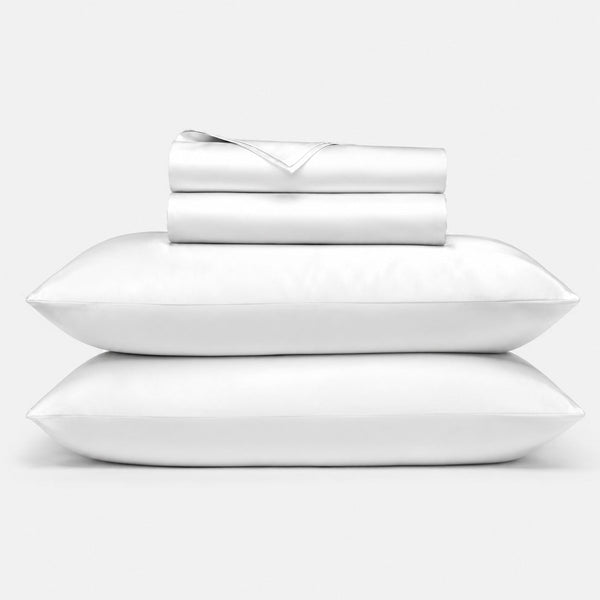
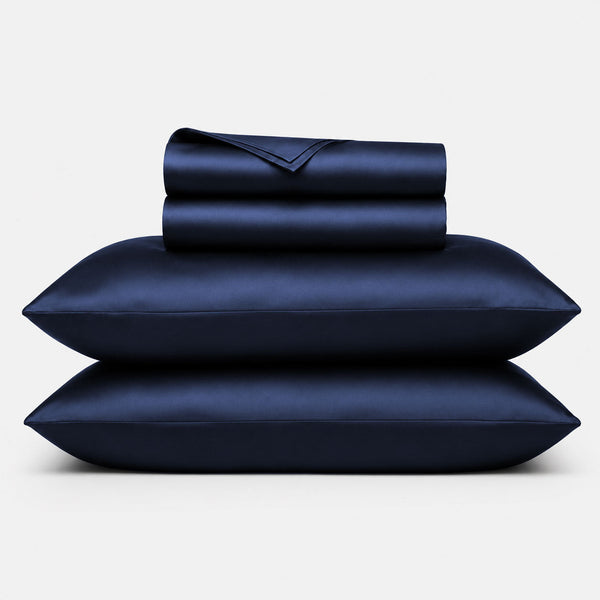
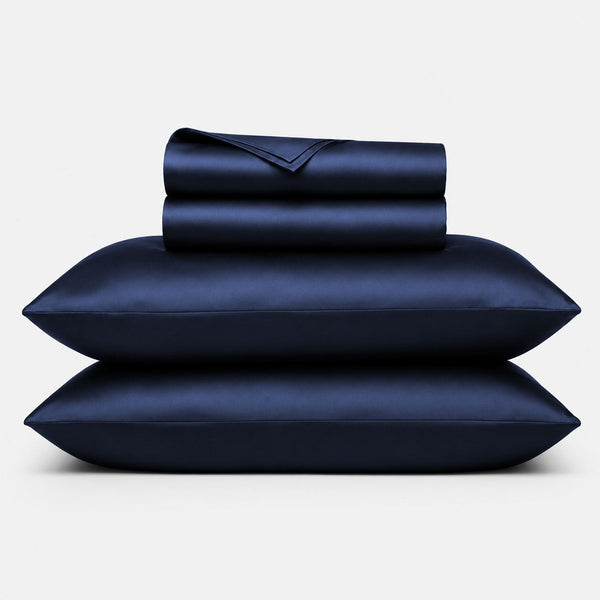
Full disclosure, since this is the point where an article like this normally starts selling: we sell sheets, including bamboo ones, and we have an obvious interest in where you land. So here is the version with the price on it. Our 100% bamboo Luxe set is 100% rayon (viscose) from bamboo, OEKO-TEX certified, with 17-inch pockets and corner straps. Queen, King and California King are $129.95; Split King is $139.95; Split Top King is $169.95. Shipping is free over $75, which every one of those sizes clears. If you decide from the table above that percale or linen suits you better, buy percale or linen — the mechanism does not care who sells it to you.
Built for the hot half of the bed
100% rayon (viscose) from bamboo · OEKO-TEX · 17-inch pockets · from $129.95.
The questions people also ask.
What type of sheet material is best for hot sleepers?
Within those four, the choice is about feel rather than performance. Percale and linen are crisp and structured. Bamboo viscose and lyocell are silky and drapey. All four beat a dense cotton sateen or a synthetic at moving heat and moisture away from skin.
Do bamboo sheets really keep you cooler?
The honest version: bamboo viscose is a smooth, absorbent, quick-drying fibre, so less damp air sits against your skin. That is a real advantage and a modest one. It will not fix a 74°F bedroom. We take the question apart in more detail in do bamboo sheets keep you cool.
What thread count is best for hot sleepers?
What type of cotton is best for hot sleepers?
Egyptian and Pima are long-staple cottons, though both terms are abused on labels. The weave matters more than the pedigree here — a mid-range percale will sleep cooler than a luxury sateen every time. We compare the two fibres directly in bamboo vs cotton sheets.
Are cooling sheets with special technology worth it?
Phase-change and cooling-treated fabrics can produce a genuine cool-to-the-touch sensation on contact. That sensation fades within minutes of your body warming the fabric, and it is not the same thing as moisture transport across a whole night.
What are the best cooling sheets on a budget?
Price and cooling performance are barely correlated. A budget percale cotton sheet outperforms a luxury sateen for the same reason a cheap window beats an expensive wall — the open weave does the work. Spend the difference on the duvet above you, where the trapped heat actually is. If you prefer a silky feel to a crisp one, bamboo viscose is the value option in that category, since its softness does not depend on paying for long-staple cotton.
How should I wash sheets if I sweat at night?
Fabric softener is the single most common way people ruin breathable sheets. Full method in how to wash bamboo sheets.