The wake-up is not the problem. You have been surfacing in the small hours your whole life and sleeping straight through the memory of it. What changed is that one night you opened your eyes, looked at a clock, and started doing arithmetic. This is a playbook for the twenty minutes after that.
Brief awakenings around 3 a.m. are a normal feature of sleep architecture, not a malfunction. The trouble starts when you check the clock and begin calculating how little sleep is left, which reliably makes the next hour worse. The fix is behavioural and unglamorous: no clock, out of bed after roughly twenty minutes, and a bedroom that is cool and dry rather than warm and damp.
Everyone wakes at 3. Most people never find out.
Human sleep is not a single block. It moves in cycles of roughly ninety minutes, cresting from deep slow-wave sleep into progressively lighter stages, and the boundary between one cycle and the next is a natural thinning of the ice. Late in the night the deep sleep has largely been spent, the cycles skew light and REM-heavy, and the thinning becomes easy to fall through. Nearly everyone surfaces there. The difference between a good sleeper and a frustrated one is frequently nothing more than whether the surfacing got encoded as a memory.
That is worth sitting with, because the first thing a 3 a.m. waking does is convince you it is evidence of something. A body that wakes briefly at the top of a sleep cycle is a body doing exactly what the design calls for. What happens in the following minutes is where a normal night is either preserved or dismantled.
The awakening is architecture. The hour you spend awake afterwards is a habit.
The distinction the whole piece rests onCortisol is rising. It is probably not the alarm.
The popular explanation is a cortisol spike. There is something real underneath it: cortisol follows a strong daily rhythm, bottoming out around midnight and climbing through the early morning hours toward a peak near waking. If you are awake at 3 a.m. and feel a peculiar wired clarity, you are awake on the rising limb of that curve, and the sensation is not imagined.
The asterisk is that the direction of causation is contested, and 2025 made it more so. Analysing tissue-free cortisol from 201 healthy volunteers by ambulatory microdialysis, Lightman and colleagues found no evidence of any change in the rate of cortisol increase in the hour after waking compared with the hour before it (Proceedings of the Royal Society B, 2025). Their reading is that the rise people attribute to waking up is simply the ordinary morning slope, already underway. Cortisol is the weather in the room. It is a weaker candidate for the thing that opened your eyes than the internet suggests, and any article that tells you to attack your 3 a.m. cortisol is selling something.
Nothing here is a diagnosis. Early waking that is persistent, or that arrives with pain, breathlessness, snoring, low mood or a new medication, is a conversation for your doctor rather than for a sheet company's blog.
The hour your ancestors expected.
In 2001 the historian A. Roger Ekirch published Sleep We Have Lost in the American Historical Review, assembling hundreds of references from pre-industrial Europe to a night taken in two shifts: a first sleep, an interval of quiet wakefulness lasting an hour or so, and then a second sleep until dawn. People used the interval. They prayed, talked, thought, made love, tended fires. Nobody appears to have panicked about it.
Laboratory work points the same way. When Thomas Wehr moved volunteers from a sixteen-hour day to a ten-hour one, their sleep expanded and split into two bouts separated by a waking interval of one to three hours (Journal of Sleep Research, 1992). Given long winter darkness, human sleep divides.
State the contest honestly: the historical claim is disputed. A 2023 reconsideration in Medical History argued that the early modern English evidence does not support segmented sleep as the universal norm Ekirch describes, and Ekirch replied in the same journal. So do not take from this that you are meant to be awake at 3 a.m. Take the narrower and better-supported point: a wakeful interval in the middle of the night has a long human pedigree, which is a reason to stop treating yours as an emergency.
Five moves for the twenty minutes after you wake.
The first two moves are the ones that matter, and neither is intuitive, because both require you to do less rather than more.
| Move | What to do | Why it works |
|---|---|---|
| 1 · Do not look | No clock, no phone. Turn the display away before bed so the decision is already made. | Tang, Schmidt and Harvey had poor sleepers monitor a clock while trying to sleep; the monitors reported more pre-sleep worry and took longer to fall asleep than non-monitors (J Behav Ther Exp Psychiatry, 2007). |
| 2 · Leave after ~20 minutes | If you are still awake and irritated, get up. Dim light, dull book, no screens. Return when sleepy, not when you decide you ought to be. | Stimulus control, formalised by Bootzin in 1972, keeps the bed associated with sleeping rather than with lying awake. A 2024 network meta-analysis in the Journal of Sleep Research found it an effective component of insomnia treatment. |
| 3 · Drop the arithmetic | Ban the calculation of hours remaining. If the mind insists, give it something dull and repetitive instead. | The maths converts a neutral awakening into a performance you are already failing, and the resulting arousal is what actually keeps you up. |
| 4 · Fix the bedroom first | Cool, dark, quiet. Most guidance lands around 60 to 67 degrees Fahrenheit, and bedding that traps heat and damp undoes a correct thermostat. | A warm, humid microclimate produces exactly the late-night surfacing you are trying to prevent. Our bedroom temperature protocol covers the full setup. |
| 5 · Audit the evening | Alcohol within three hours of bed, and caffeine later than you think. | Alcohol shortens sleep onset and consolidates the first half of the night, then disrupts the second half as it clears (Ebrahim et al., Alcoholism: Clinical and Experimental Research, 2013). Caffeine arithmetic is in our half-life piece. |
One more item, less a move than a floor: a consistent schedule. Hold the same bedtime and, more importantly, the same wake time every day, including after a bad night. The common instinct is to sleep in, go to bed earlier the following evening, or nap to clear the deficit, and all three push the next night further out of phase. Avoid the make-up nap in particular. Getting up at a fixed hour is the cheapest lever there is on nighttime consolidation, and it is the first one most people abandon.
Notice what is absent. No supplement, no breathing pattern sold as a switch, no app. The evidence sits with boring behavioural moves practised consistently for two to four weeks, which is a genuinely worse story than a hormone hack and a considerably more useful one. These moves are the backbone of cognitive behavioural therapy for insomnia, the first-line treatment recommended by the American Academy of Sleep Medicine, and they work on ordinary stress-broken nights as well as on diagnosed ones.
If you take one thing: the clock is the enemy, not the waking. A person who surfaces at 3 a.m., rolls over and never learns the time has had an ordinary night. The same person, informed that it is 3:07 and that the alarm is at 6:15, now has a problem to solve at the precise hour when the brain is least equipped to solve anything.
Where the sheets honestly matter.
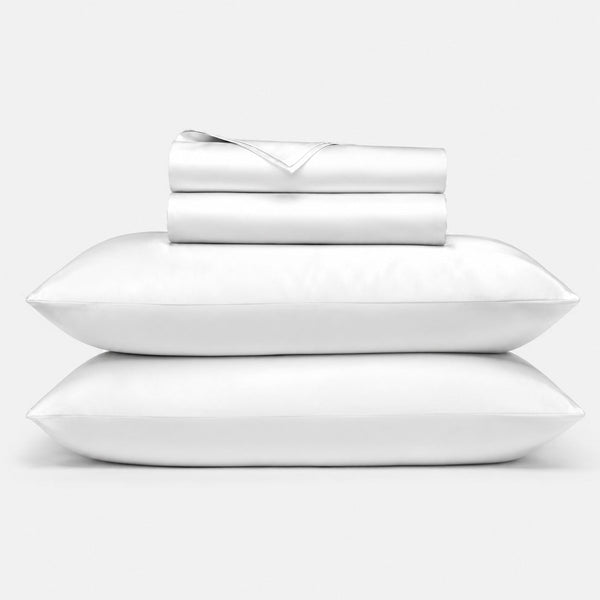
We sell sheets, so treat this section with appropriate suspicion. Bedding will not fix stress, apnoea or a hormonal shift, and anyone who tells you otherwise is not being straight with you. What bedding does control is the microclimate against your skin for eight hours: whether the heat your body sheds through the night leaves the bed, and whether the moisture goes with it. A hot sleeper waking damp at 3 a.m. is having a thermal problem as well as whatever else is going on, and that part is fixable with a fabric change.
Our position, argued at length in do bamboo sheets keep you cool, is that 100% rayon (viscose) from bamboo moves moisture away and dries faster than cotton, which absorbs and holds it. That is a real mechanism with a modest effect size, not a cure. If your 3 a.m. wake-ups arrive with a damp back and kicked-off blankets, it is worth changing. If they arrive with a racing mind in a perfectly cool bed, no sheet on earth will help and we would rather say so.
If the bed is the damp part
100% rayon (viscose) from bamboo · 17-inch pockets, corner straps · from $129.95 · free shipping over $75.
The questions people also ask.
How do I break the cycle of waking up at 3am?
The cycle is maintained by what happens after the waking, not by the waking itself. Clock-checking supplies the anxiety and lying in bed awake teaches your brain that the bed is a place for being awake. Removing both is the whole intervention, and it is slower and duller than any shortcut on offer.
What hormone wakes you up at 3am?
Cortisol is better understood as the background than as the trigger. Treat confident claims about a 3 a.m. cortisol spike, and any product sold to suppress it, with scepticism.
Is waking up at 3am normal?
By 3 a.m. most of the night's deep sleep has already been taken, so the remaining cycles run through lighter stages and REM. That is why the middle of the night feels different from the beginning, and why a noise that would not have reached you at 11 p.m. lifts you clean out of sleep at three.
Why do I wake up at 3am and cannot go back to sleep?
Falling asleep again is not something you can force by trying harder; effort raises arousal, which is the opposite of what is required, and the anxiety about it compounds fast. Leaving the bed, staying in dim light and returning when genuinely sleepy is the move with the evidence behind it.
When is waking up at 3am a health problem?
Occasional 3 a.m. waking is common and unremarkable. A persistent pattern can be associated with an underlying condition, and it can equally be a side effect of something ordinary you already take. Claims tying the hour to blood sugar swings circulate widely online but are presented with far more confidence than the evidence supports. Your doctor can work out which of these actually applies to you, and that is genuinely the right place for the question.