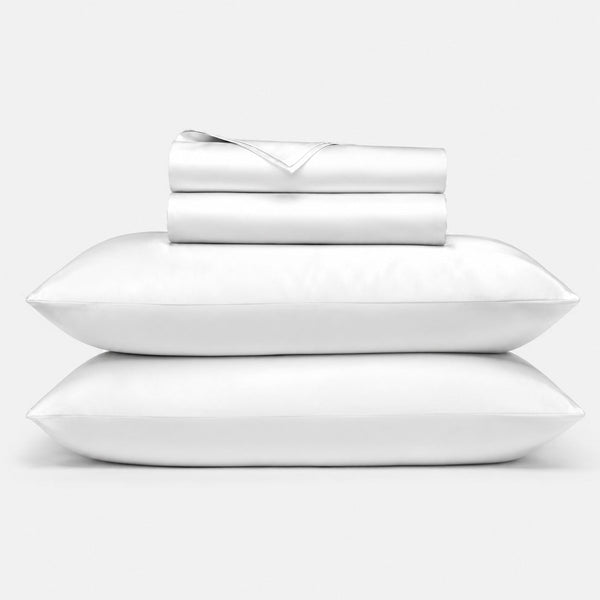
There is a moment on the first night of a trip when you get into a hotel bed and something is plainly, annoyingly better than what you have at home. The sheet is cool against your calves. It is smooth without being slippery. It makes a sound. And somewhere in the back of your head a small voice says: I should find out what these are and buy them.
You can. But almost nobody who goes looking finds what they are actually looking for, because the thing they liked was not entirely the sheet. It was a fabric, a machine, and a schedule, and only one of those three is for sale.
Hotel sheets are usually cotton percale somewhere in the 200 to 400 thread count range, which is lower than most of the bedding marketed to you at home. A large part of what you feel is not the sheet at all - it is a high-temperature wash with no fabric softener, a heated industrial press, and linen that is changed after every guest. The crisp is buyable. The freshness is a laundry schedule.
The crispness is a weave, and it is not expensive
Ask a linen buyer at a hotel group what they specify and you will not hear a number that would impress anyone in a bedding aisle. Commercial linen suppliers consistently quote a working range of roughly 200 to 400 threads per inch for hotel bed sheets, with percale sitting at the lower end of that band and sateen at the upper end. The reason luxury hotel bedding clusters there is not thrift. It is that the fabric has to survive several hundred industrial wash cycles and still breathe, and both of those get worse as you cram more yarn into the same square inch.
The percale weave is a plain weave: one yarn over, one yarn under, repeating. That structure is what creates the crisp hand and the faint papery rustle. It also leaves more air space between the yarns than a sateen does, which allows air to move through the cotton sheet instead of sitting in it. That is why a percale sheet reads as breathable and crisp, cool rather than warm and silky. Sateen uses a float - one yarn passing over three or four before it tucks under - and that unbroken run of surface yarn is what makes sateen smooth and lustrous. Neither weave is better. They are answers to different questions, and we have written the long version of that comparison in percale versus sateen.
Thread count itself is a weaker signal than the industry has trained you to believe. The standard test method behind the number, ASTM D3775, simply counts ends and picks - the warp and filling yarns crossing a measured inch of woven fabric. There is a physical ceiling to how many yarns of usable thickness fit in an inch, and once a marketing department wants to print a bigger number than the loom can produce, the arithmetic has to come from somewhere else. Above roughly 600, treat the figure as a claim rather than a measurement. Hotels, notably, do not chase it. High thread count fabrics breathe worse and wear out faster under commercial laundering, which is a fairly damning practical review from the only buyers in the industry who wash the same sheet a thousand times.
Egyptian cotton is the other word that gets attached to hotel quality. It refers to extra-long-staple cotton grown in the Nile delta, and long-staple fibre genuinely does spin into smoother, stronger, less pill-prone yarn. Woven into a sheet, that shows up as a softness that survives washing rather than a finish that rinses out, and it is the one place where the high-quality label is doing real work. It is worth knowing that the phrase is widely borrowed by products containing no Egyptian cotton at all - including, to be blunt about our own catalogue, sheet sets sold across this industry under names like Egyptian Comfort, which is a product name and not a fibre origin. Read the fibre content line, not the front of the package.
Most of the feeling is a machine you do not own
Here is the part that almost every article about hotel bedding skips, because it cannot be converted into a product recommendation. Hotels do not just buy the fabric, they maintain it, and the maintenance is most of the effect. After the sheet comes off the bed, it goes through a wash cycle far more aggressive than anything you would run at home: high water temperature, strong alkaline detergent, and no fabric softener. Softener is banned in most commercial laundries because it coats fibres, reduces absorbency and interferes with finishing. That absence is a large part of why a hotel sheet feels clean rather than merely soft.
Then it goes through a flatwork ironer - a heated roller press that dries and finishes the sheet in one pass, with the chest run as hot as the linen will tolerate. This is the single biggest contributor to the effect you are chasing, and it is always the one people leave out when they try to recreate a hotel bed at home. A domestic iron applied to a whole flat sheet is a joke of a Saturday. That pressed, flat, faintly glazed surface is a thousand-pound machine, not a fabric choice.
And the sheet is new, relatively speaking. Hotels rotate linen out of service on a schedule, so the set you slept on has a fraction of the wash-and-body-oil history of the set on your own bed. If your sheets have not felt like anything in two years, the honest first suspicion is not the sheets. It is buildup - detergent residue and softener film - and it is often reversible. Our washing guide covers the strip-and-reset version of that for cellulose sheets.
The last piece is triple sheeting: flat sheet, blanket, second flat sheet, no duvet cover. Hotels adopted it because it launders completely between guests and signals cleanliness on sight. It also happens to produce that tight, cool, layered bed you cannot quite build at home. It is a housekeeping standard that got mistaken for a comfort feature, and it works as both.
Cool to the touch is real, and it is very short
The cool-on-contact sensation is not folklore and it is not vague. It has been an instrumented property of textiles since 1977, when Sueo Kawabata at Kyoto University identified a strong correlation between the initial peak heat flux out of the skin and the warm or cool feeling a fabric gives on first touch. That value is called qmax, it is measured on the KES-F7 Thermo Labo as part of the Kawabata Evaluation System, and it is standardised in Japan as JIS L 1927. When a bedding brand says cool to the touch, this is the number they are pointing at, whether or not they have ever measured it.
Now the important caveat, which the industry very rarely volunteers. Qmax describes the first seconds of contact. It is a measure of how quickly heat leaves your skin at the instant the fabric arrives, driven mostly by the surface structure and the fabric density - the properties that make a smooth, flat, well-pressed percale feel like a cold plate. Within a few minutes your body has warmed the contact patch and the effect is finished.
The hotel sheet feeling is mostly a getting-in feeling. It tells you almost nothing about what that bed will be at three in the morning.
The Fabric FilesThis is why people come home from a good hotel, buy the crispest percale they can find, and are still hot at 3am. They bought the right fabric for the wrong half of the night. Contact coolness and overnight heat management are two different properties, and the marketing word cooling is used for both.
What actually decides the rest of the night
The overnight variable is heat and moisture leaving the bed rather than pooling in it. That is a question of breathability, of how much fibre and finish sit between you and the room, and of how well the material handles the water your body puts into it. It is a slower and less dramatic property than qmax, and it is the one that survives to the small hours.
The sleep literature is fairly consistent that this matters. Okamoto-Mizuno and Mizuno, reviewing the field in the Journal of Physiological Anthropology in 2012, concluded that heat exposure increases wakefulness and reduces both slow wave sleep and REM sleep, and that bedding and clothing substantially change how much of that heat load ever reaches you. Working in the other direction, Raymann, Swaab and Van Someren showed in Brain in 2008 that raising skin temperature by only 0.4 degrees Celsius, without moving core temperature, suppressed nocturnal wakefulness and shifted sleep toward deeper stages. Small thermal changes at the skin are not trivial. That is the mechanism your bedding is operating on all night, and it is a far better reason to care about fabric than any thread count on a box. Neither of those papers is about sheets specifically, and neither one licenses a health claim - if your sleep is badly disrupted, that is a conversation for your doctor, not a bedding purchase.
We have written separately about what fibre can and cannot do for that half of the problem in do bamboo sheets keep you cool, including the limits.
Recreate the parts that are actually the sheet
So the useful way to ask why hotel sheets feel the way they do is to sort the experience into three columns: what you can buy, what you can change for free, and what belongs to a commercial laundry. Most of the disappointment in this category comes from people spending money on the third column, which is the one thing no retailer can offer them.
| What the hotel does | Why it works | What transfers home |
|---|---|---|
| Cotton percale, roughly 200-400 TC | Plain weave leaves air space; crisp hand, breathable | Fully. Buy percale and stop reading thread counts |
| No fabric softener, ever | Softener coats fibre and kills absorbency and crispness | Fully, and it is free |
| High-temperature wash after every guest | Strips body oils and detergent residue completely | Partly. Wash weekly; strip-wash an old set once |
| Heated flatwork ironer | Presses the surface flat and slightly glazed | Barely. This is the piece you cannot buy |
| Triple sheeting, no duvet cover | Tight layered bed, everything launders | Fully, if you will make the bed properly |
| Linen retired on a rotation | You are never sleeping on a five-year-old sheet | Partly. Replace sets before they feel dead |
| Blackout curtains, cool room | Thermal and light environment, not bedding | Fully, and it outperforms most sheet upgrades |
One disclosure, since this is a piece about buying advice on a site that sells bedding. We do not make percale. If crisp is the thing you fell in love with in that hotel room, buy percale from someone who makes good percale - that is the honest answer and we would rather give it than sell you the wrong feeling. What we make is a sateen, and it is aimed at the other half of the problem: the fibre is 100% rayon (viscose) from bamboo, which is a smooth, silky, cool-sleeping hand rather than a crisp one. If what you actually liked about the hotel bed was that you did not wake up hot, that is a fibre and breathability question, and it is the one we are built for. If what you liked was the rustle, we are not it.
Worth knowing while you shop, since almost nobody labels this correctly: under the FTC textile rules at 16 CFR Part 303, fabric made from bamboo by the viscose process must be described as rayon or viscose made from bamboo, not as bamboo. The FTC has fined national retailers over exactly this. A set advertised as 100% bamboo with no mention of viscose is a label problem before it is anything else.
100% Bamboo Luxe Sheet Set
100% rayon (viscose) from bamboo, sateen weave. From $129.95. Free shipping over $75.
If you want the groundwork underneath all of this - weaves, fibres, sizes, what the numbers on a package mean - it is collected in bed sheets 101.
Common questions
What thread count do hotels actually use?
Commercial linen suppliers converge on that band because the ideal figure is the one that balances comfort against surviving hundreds of industrial wash cycles. Very high thread count fabrics breathe worse and wear faster under that treatment, so hotels avoid them. If a retail set advertises a number several times higher than a luxury hotel specifies, that gap is telling you something about marketing rather than about quality.
Is it percale or sateen in hotels?
Percale is a one-over-one-under plain weave, which leaves more air space and produces the cool, crisp, faintly rustling hand people associate with a hotel bed. Sateen floats yarn over three or four others for a smoother, more lustrous, slightly warmer surface. Some upper-tier hotels offer a choice between the two, which is a reasonable admission that this is a preference rather than a ranking.
Why do my sheets never feel like that even though they cost more?
Softener leaves a film that flattens crispness and absorbency, and it accumulates. Detergent residue and body oils do the same over years. Before replacing a set, try washing it hot with no softener and a second rinse and see what comes back. The pressed finish, though, genuinely is a machine you do not have.
What is triple sheeting?
It started as a hygiene and cost decision rather than a comfort one, since it removes the unwashed comforter from the equation. The side effect is the tight, cool, flat bed guests remember. You can do it at home for the price of one extra flat sheet.
Does cool to the touch mean the sheets sleep cool all night?
The measurable version is qmax, identified by Sueo Kawabata in 1977 and standardised as JIS L 1927. It captures the initial heat flux out of your skin at the moment of contact. Staying cool overnight is a different property - breathability and moisture handling - and a fabric can be strong on one and ordinary on the other.
Is Egyptian cotton worth paying for?
Long-staple fibre spins into smoother, stronger yarn that pills less, and that is a durable material benefit rather than a story. The problem is that the term is used loosely across the industry, including in product names that contain no Egyptian cotton. Check the fibre content statement, which is regulated, rather than the marketing name, which is not.
Can I get the hotel feeling from bamboo sheets?
If what you loved was the rustle and the papery hand, that is percale and no cellulose sateen will imitate it. If what you loved was getting into a bed that was not warm and staying comfortable in it, that is breathability and moisture handling, and that is where a smooth 100% rayon (viscose) from bamboo sheet earns its place. Buy for the half of the experience you actually missed.
How often should I wash my sheets to maintain that feeling?
A hotel washes after every guest, which is why the softness you meet there is never buildup-softness. At home, weekly is a reasonable target for the same reason: body oils and detergent residue create the dull, slightly limp hand that people mistake for worn-out fabric. Skipping fabric softener permanently does more to maintain a crisp finish than any upgrade you can buy.