Bedding has a vocabulary problem. Half the words mean two things, the other half mean nothing, and the industry likes it that way — confusion sells thread count. This page is the plain-English decoder: short answer first, full answer after.
What is a bed sheet called, technically?
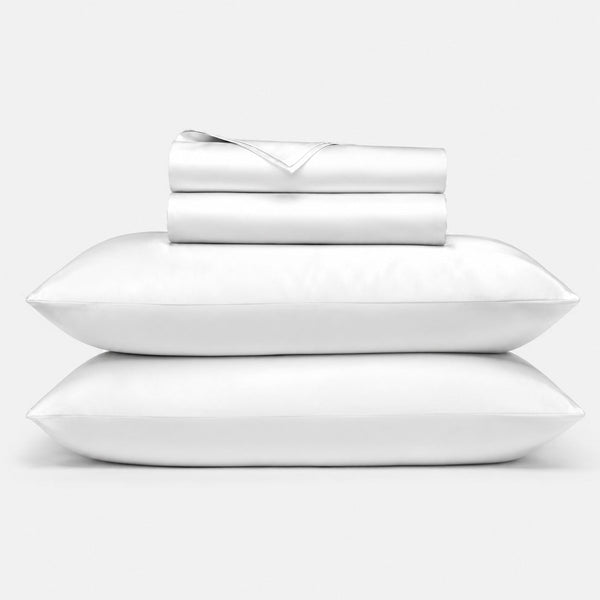
That's the whole taxonomy. A “bedding set” usually adds a duvet cover or comforter; a “sheet set” is fitted + flat + pillowcases. When a listing says “4-piece set,” count: one fitted, one flat, two pillowcases — Twin sets often have three pieces (one pillowcase).
Is it “bedsheet” or “bed sheet”?
Search engines treat them as the same query, so spell it however feels natural. Retail listings in the US overwhelmingly use “bed sheets,” which is why you'll see that form on our packaging too.
Is it “bedding” or “bed sheets”?
If you're buying the things that touch your skin, you're shopping for sheets. If you're redoing the look of the whole bed, that's bedding. The distinction matters mostly because “bedding sets” often bundle a comforter with low-grade sheets — the piece that matters least gets the budget, the pieces that touch you all night get the leftovers.
Do you actually need a top sheet?
The case for: it's the easiest layer to wash, and on hot nights it can be the only layer. The case against: one more thing to untangle. There is no wrong answer, whatever your mother-in-law says.
Which type of bed sheets is best?
| You are… | Buy | Because |
|---|---|---|
| Hot, sweaty, or menopausal | 100% bamboo viscose sateen | Breathes and wicks better than cotton; silky drape |
| A crisp-sheets purist | Cotton percale, 300–400 count | Cool crackle, matte finish, gets softer with age |
| Practical, budget-first | Brushed microfiber (like our 1800 series) | Cheap, tough, wrinkle-free, easy care |
| A texture person | Linen | Most breathable natural fiber; lasts decades; rumpled look is the point |
| Cold at night | Flannel or heavier cotton sateen | Insulation beats breathability when you sleep cold |
We sell two of those five — bamboo and microfiber — and we'll still tell you percale or linen is the right call for the sleepers described above. The wrong fiber in the right thread count is still the wrong sheet.
What's the difference between percale and sateen?
Percale feels like a pressed dress shirt; sateen feels like a silk-adjacent ribbon. Bamboo viscose is usually woven sateen because the smooth fiber amplifies the effect — that's the “buttery” everyone describes.
Is thread count actually important?
Thread count counts threads per square inch — but marketers count each strand in a twisted multi-ply yarn separately, which is how “1800” appears on packaging (ours included — in our case it's a series name for brushed microfiber, and we say so). Judge sheets by fiber, weave, and hand-feel; treat any count over 600 as a marketing decision, not an engineering one.
What are deep pocket sheets, and do I need them?
Measure mattress height including any topper. Ours run 17" with elastic straps on every corner because modern mattresses keep getting taller — the single most common cause of the popped-corner complaint isn't sheet quality, it's pocket math.
Twin XL vs Full — what's the difference?
| Twin XL | Full (Double) | |
|---|---|---|
| Dimensions | 38 x 80 in | 54 x 75 in |
| Sleeps | One adult, comfortably | One adult with room to move |
| Best for | Tall sleepers, dorms, narrow bedrooms | Guest rooms, teenagers, solo sleepers who roll |
| Room it wants | About 7 x 10 feet | About 10 x 10 feet to walk around |
| The catch | Too narrow to share | Five inches shorter — a six-foot adult hangs off |
Twin XL stands for extra long, and it is the standard mattress size in nearly every college dorm — which is the single most common reason anyone buys one. A full mattress, confusingly, is not full-size in any meaningful sense; the name is a holdover from when it was the largest bed most households owned.
The deciding factor is almost always the dimension you are short of. A Twin XL is a single bed, five inches longer than the standard single; if you are over six feet tall that length matters more than any amount of width, because no width fixes feet over the end. A Full is the wider option, and for one person who moves in the night it is the more comfortable choice of the two.
For a couple, consider the arithmetic before you consider the price: a Full gives each person 27 inches of space, narrower than a standard Twin each. That is why most couples who look at a Full end up choosing a Queen instead. A Full is a compromise, not a couple's mattress size. Cost rarely settles the question either — the two sizes sit close enough in price, sheets included, that the room and the sleeper should make the call.
One more thing that catches people out: two Twin XL mattresses pushed together measure exactly a King, 76 x 80. That is why Twin XL keeps appearing in split king and adjustable-bed setups, and why a Twin XL sheet is the piece you buy when only one side of the bed moves. The full Twin XL vs Full comparison has the rest.
Is a Twin XL or a Full better for a guest room?
The guest room is the one place where the usual advice inverts. You are fitting the widest range of unknown bodies rather than your own, and a Full covers more of them with less thought. The exception is space: a Full wants roughly ten feet of wall plus walking room on one side, while a Twin XL will fit a bedroom a Full simply cannot.
King vs California King vs Split King — which do I have?
Measure the mattress, not the frame. Full comparisons: King vs Split King, Split King vs Split Top King, and the flex top king decoder — or the whole chart in the size guide.
How often should you wash your sheets?
You shed roughly a shot glass of sweat and millions of skin cells nightly. Two-week cycles are fine for most; hot sleepers, allergy sufferers, and anyone sharing the bed with pets should stay weekly. Cold-wash fibers like bamboo make frequent washing cheaper on energy and gentler on fabric.
How many sheet sets should you own per bed?
The rotation isn't retailer math — fabric rested between uses lasts disproportionately longer, and laundry day stops being an emergency. Guest rooms survive fine on one.
What is microfiber, and is it any good?
Microfiber is what most “1800 series” sheets are, ours included — honest label: brushed polyester microfiber, and at its price it's very hard to beat for kids' rooms, rentals, and anyone who hates ironing. When customers outgrow it, it's almost always for temperature reasons, and that's the fiber conversation.
Whatever you sleep on, fit it right
17" deep pockets · corner straps · Queen to Split Top King · bamboo viscose or 1800 microfiber.
Go deeper down the rabbit hole.
The bamboo-specific truth database lives here: Bamboo Sheets: Every Question, Answered — including the downsides no one prints.