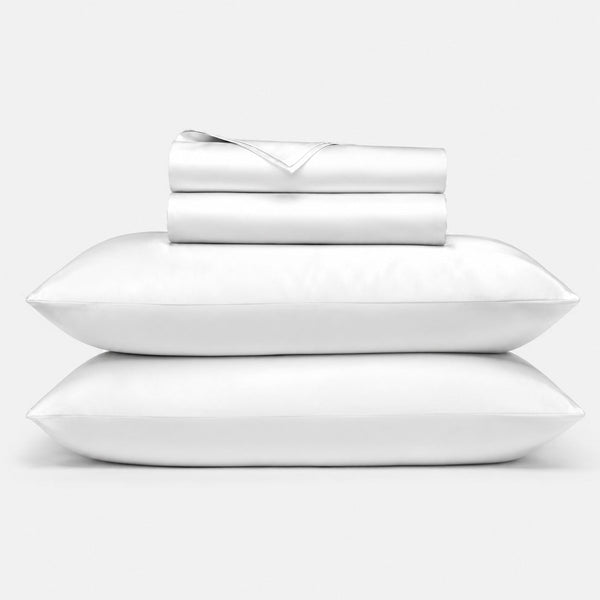
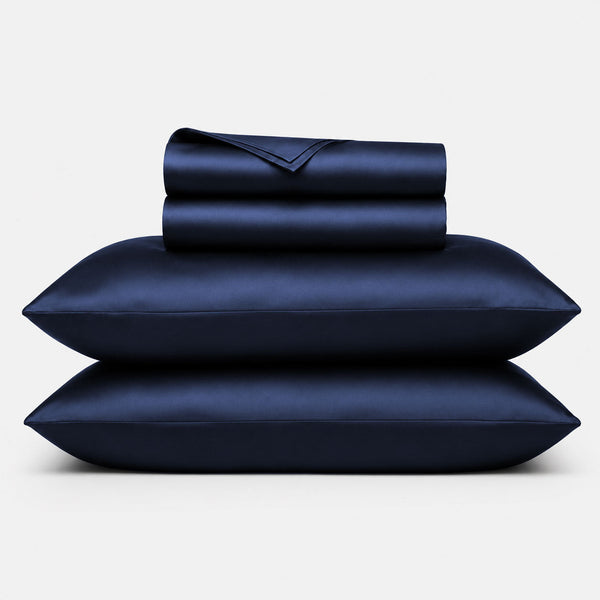
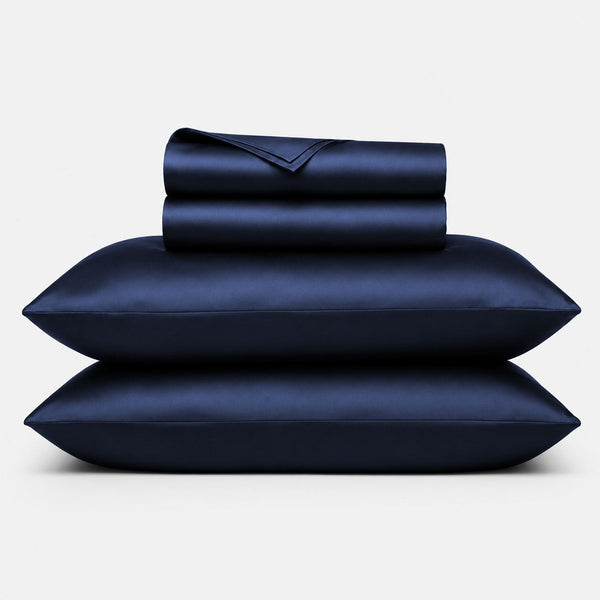
The sheet on your bed started as a twenty-foot stalk of grass that nobody watered, sprayed, or replanted. Here's the whole journey — farm, mill, loom, container ship, Houston — with the parts most brands skip because they're either too technical or too honest.
Bamboo is harvested (it regrows from its own roots), pulped into cellulose, dissolved and re-spun into smooth viscose filaments, woven into sateen, cut and sewn into sheets, quality-checked, and shipped. The fiber-making step is real chemistry — covered honestly in What Is Bamboo Viscose? — and the finished fabric is tested (OEKO-TEX) before it touches your bed.
A grass that farms itself.
Moso bamboo grows up to three feet a day, drinks rainwater, needs no pesticides, and — because it's a grass — regrows from the same root system after harvest. No replanting, no tilling, no irrigation infrastructure. As a raw material it embarrasses cotton, which is why the fabric's eco story starts strong (and why we're careful it doesn't get oversold from there).
Stalk to silk-adjacent.
The stalks are chipped and pulped to extract cellulose, which is dissolved and forced through spinnerets to regenerate as long, round, uniform filaments — the viscose process. Those smooth filaments are why bamboo feels silkier than cotton at the same thread count: the softness is engineered into the fiber's shape, not woven in later. The chemistry, the safety answer, and the FTC labeling rules get their own straight-talk article: What Is Bamboo Viscose — and Is It Safe?
Where good sheets are won or lost.
The yarn is woven into sateen — threads floating over the surface for that lustrous, drapey hand. Then construction: panels cut oversized for first-wash shrink, elastic sized so the fitted sheet grips without fighting you, corner straps sewn on every corner (including the middle pieces of our split top king), and 17-inch pockets because mattresses keep getting taller.
Last stage is proof: OEKO-TEX Standard 100 testing on the finished textile — dyes, finishes, residues — so the safety claim is a certificate, not a vibe. Then the sheets are packed dense (we removed the pallets from our containers to fit more product per shipment — boring logistics is a real part of how the price stays down) and sailed to Houston.
The fiber is made in a lab, the softness is made in the weave, and the price is made in the container.
The supply chain in one lineThe finished product of all that
100% rayon (viscose) from bamboo · sateen weave · OEKO-TEX tested · 17" pockets + straps · from $129.95.