Somewhere in the first month of owning an adjustable bed, the flat sheet picks a side. Either it stays — tucked, retucked, smoothed back every morning — or it comes off on a laundry day and quietly never returns. This is one of the few bedding questions with two honest answers. You do not need a flat sheet on an adjustable bed. You may still want one. Here are both cases, made fairly, and then the part nobody writes down: how to make the thing behave if it stays.
No — a flat sheet is a preference, not a requirement, and an adjustable bed punishes it more than a flat bed does because the head section drags an anchored sheet loose every time it rises. Keep it if you want a light summer layer and a barrier that spares the duvet cover a weekly wash; drop it and the migration problem disappears entirely, at the cost of laundering that cover far more often. If you keep it: make the bed in the flat position, tuck at the foot only, and skip the tuck altogether if you raise the foot section.
The sheet is fine. The geometry is not.
On a conventional mattress a flat sheet has one job — lie still — and a foot tuck holds it there because nothing ever moves. An adjustable bed breaks that bargain nightly. Raise the head and the surface under the sheet stops being a flat plane and becomes a slope with a bend in it; the fabric has to come from somewhere, and it borrows from the loosest point, which is the tuck at the foot. Lower the head and the slack does not walk itself back. Repeat nightly and the tuck ratchets loose a little at a time — fine on Sunday when you make the bed, a loose diagonal by Thursday.
Raising the foot section is gentler — fabric pools instead of pulling — but add a sleeper sliding a few inches down an incline and taking the sheet along, and you have why flat sheets on adjustable beds carry a reputation they never earned on flat ones. The sheet is not coming loose because it is cheap. It is coming loose because the bed changes shape and the tuck does not. We wrote about this sheet creep, among the other things nobody mentions in the store, in our owner's diary of living with a FlexTop King.
The sheet is not coming loose because it is cheap. It is coming loose because the bed changes shape and the tuck does not.
On the nightly ratchetWhat the flat sheet still does better than anything.
The strongest argument for the flat sheet is laundry arithmetic. A top sheet is the washable layer between you and the duvet, and it is the easiest large item in the house to wash — no buttons, no zip, no wrestling a comforter back into a cover. Keep one on the bed and the duvet cover can go a month between washes instead of a week. Drop it and the cover becomes the sheet, with the sheet's washing schedule and none of the sheet's convenience. A split top king load has more pieces than any other bed in the house to begin with — we wrote a whole piece on washing this size without losing track of them.
The second argument is temperature, and it is a Sun Belt argument. A flat sheet is the lightest layer a bed can offer, and for a good stretch of the year it is the only cover a hot sleeper needs. Strip it away and the two-in-the-morning options are the full duvet or nothing. For two people who run at different temperatures — most couples on a split-head bed — it is also the cheapest per-side comfort control there is: one under sheet and duvet, one under sheet alone, nobody negotiating. That division of the bed is a subject we took seriously in the case for the split top.
And the plain sensory point deserves better than being dismissed as habit: a smooth, cool, tightly woven flat sheet against the skin is most of what people are buying when they buy expensive bedding. Plenty of owners run a crisp Egyptian cotton flat over a bamboo fitted sheet, or the reverse, and the mix is fine — the two pieces never touch each other's jobs.
The Europeans have a point, especially here.
Most of Europe sleeps under a duvet in a washable cover and no flat sheet at all, and loses no sleep over it. On an adjustable bed the case gets stronger: the migration problem from chapter one does not need managing if the migrating layer is not on the bed, and a duvet has no tuck to lose — it simply rides the shape of the bed. Making the bed drops from three layers to two, and on a bed already fussier to make than a flat one, removing a step counts double.
Be honest about who else belongs in this camp: the people who were never really using the sheet. If yours ends most nights kicked into a rope at the foot of the bed, you are not a flat sheet household, and the bed will look better and wash easier without it. The cost, as above, is that the duvet cover inherits the weekly wash. If that trade reads as fine, it is fine. No fibre, hygiene or fit argument rescues a layer you do not sleep under — and a company that sells flat sheets is telling you so.
Keeping a flat sheet on a bed that will not hold still.
First, make the bed flat. Bedding goes on square only when the bed is square, and the base makers say so themselves: GhostBed's own guide to keeping sheets on an adjustable bed has you secure the fitted sheet, return the base to the flat position to pull everything taut, and only then lay and tuck the flat sheet. Tuck at the foot only, and generously — the sides of an adjustable base are usually shrouded by the frame anyway, and a side tuck is the first thing articulation tears out. If you raise the foot section at night, skip the tuck entirely; that tug-of-war ends the same way every time.
Second, know which pieces your bed actually takes, because the flat sheet is the one piece the split does not change. The split in a split top king lives in the fitted sheet — ours is one fitted piece with the split sewn in at the head — while the flat sheet up top is a standard king flat. A full split king is the same story in reverse: two Twin XL fitted sheets below, one shared king flat above, which is how GhostBed describes its own split king sets too. Nobody needs a special flat sheet; they need the right fitted one underneath it.
| Bed | Fitted sheet below | Flat sheet above |
|---|---|---|
| Split top king · FlexTop King | Split top king fitted, split at the head only | Standard king flat, 76 × 80 bed |
| Split king | Two Twin XL fitted sheets | One shared king flat |
| FlexTop California king | Split top cal king fitted | Standard California king flat |
| Adjustable queen or king, no split | Standard deep-pocket fitted for the size | Standard flat for the size |
Third, the market has noticed this problem, which is its own kind of evidence. One Bed sells its luxury adjustable-bed sets with an Easy On flat sheet with corner buttons that anchors the flat sheet to the fitted one. QuickZip engineers its corners for tilt, running about three inches under the mattress with continuous elastic so nothing pops when the head rises. DreamFit builds retention straps into its adjustable-bed sets. You do not need a system to keep a top sheet in place — the flat-position habit and a foot-only tuck solve most of it — but three companies designing hardware for one layer of fabric tells you the ratchet in chapter one is not your imagination.
Last, a sorting trick: if you run a rotation, keep the flat sheet in a different colour from the fitted. On a size with this many near-identical pieces, the contrast does the sorting before the dryer finishes.
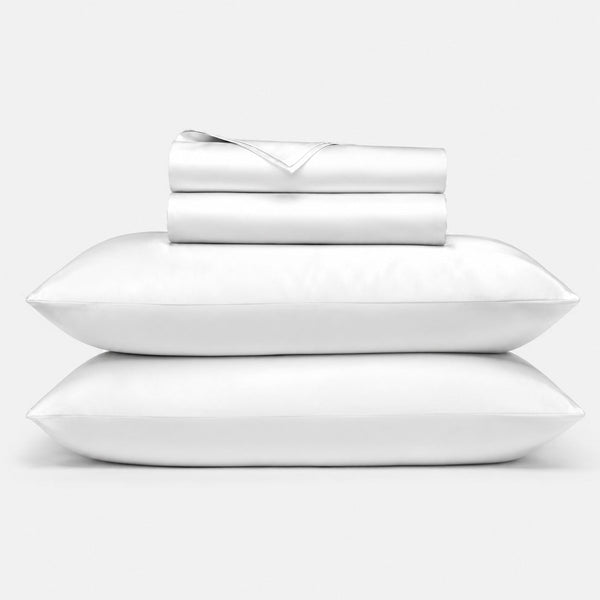
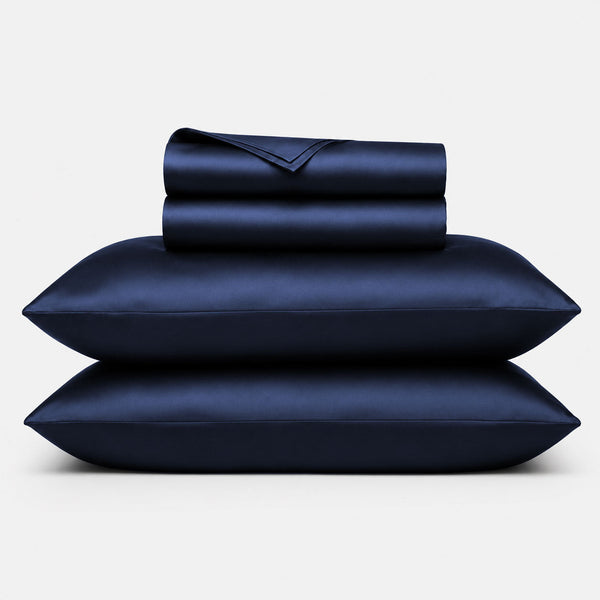
Since this piece touches product, the disclosure, plainly: we sell sheets. Our 100% rayon (viscose) from bamboo set ships complete — split-at-the-head fitted with 17-inch pockets and corner straps, the standard king flat this article has been discussing, and king pillowcases — in five sizes from Queen at $129.95 to Split Top King at $169.95. Whether the flat sheet stays on your bed is your call; it is in the box either way, and the fitted underneath does the holding.
Built for the bed that moves
100% rayon (viscose) from bamboo · split-at-the-head fitted, 17-inch pockets, corner straps · king flat included · Split Top King $169.95.
The questions owners actually ask.
Do adjustable beds need special sheets?
Special is the wrong frame. The bed takes ordinary bedding in the right geometry — the split and the depth live in the fitted sheet, and the flat sheet above it is standard for the size.
How do you keep a flat sheet tucked in on an adjustable bed?
Corner buttons, suspenders and strap systems exist for the committed, but the flat-position habit and a foot-only tuck get most beds most of the way without buying anything.
Is a flat sheet the same thing as a top sheet?
Does a split king use one flat sheet or two?
Does a split top king need a special flat sheet?
That is also why a split top king flat sheet never goes missing in the wash the way the fitted can — it is an ordinary king flat and behaves like one.