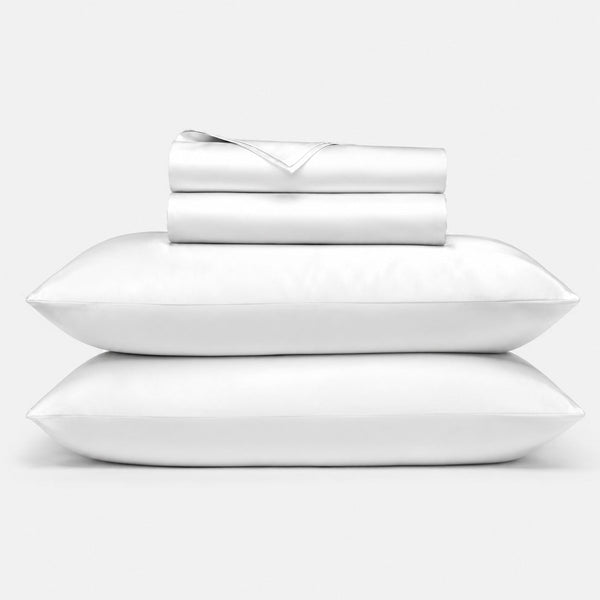
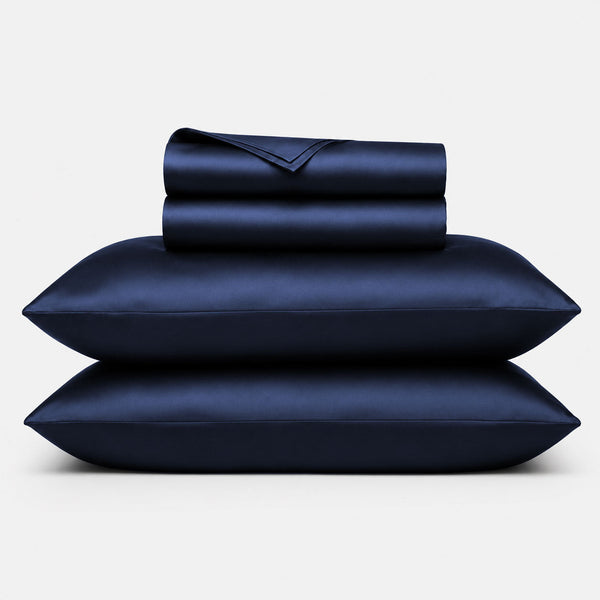
A split top king set does not come out of the dryer the way a king set does. There are more pieces, two of them are nearly identical, and the one that matters most — the panel that splits at the head — is the one you will be holding up to the light at eleven at night wondering which way round it goes. None of that is difficult. It is just unfamiliar, and nobody hands you a laundry routine when they deliver the bed. This is the one we would give you.
Wash split top king sheets on a warm or cold gentle cycle with the split panel loaded loosely and by itself if your washer is small, then tumble dry on low and pull them out slightly damp. Keep the halves together by folding the split panel first and storing the whole set inside one of its own pillowcases. The only real difference from a king set is the piece count and the extra hemmed edges at the head split, which is where wear shows up first.
Count what you are actually washing.
Start by laying the set out on the bed once, before it ever goes near a washing machine, and count. Split top king sets are not built to one standard: some ship a single fitted sheet with a sewn split running down the top, some ship the base and the two head panels as separate pieces, and a few older sets pair a full-width fitted sheet with two Twin XL toppers. Ours is one fitted piece with the split sewn in, which means the whole thing goes in as a unit. If yours arrives as separate panels, they are the pieces most likely to go missing, and the fastest way to lose track of a half is to learn its shape for the first time while it is wet.
The flat sheet, if you use one, is the only genuinely king-sized item in the bundle, and it is the piece that fools people — it looks like the base panel when it is balled up. Pillowcases are ordinary king pillowcases and can go in with anything. So the sort is simple: split panel in one hand, flat sheet in the other, pillowcases wherever they land. That is the whole trick, and it saves the ten-minute rummage through a laundry basket that most owners of this bed have done at least once.
| Piece | What to watch for | How we wash it |
|---|---|---|
| Split fitted panel | Corner straps tangle; the sewn head split takes the most stress | Fasten or tuck the straps, load loosely, gentle cycle |
| Flat sheet | Wraps around everything else and traps the rest in a ball | Load second, unfolded, never stuffed in as a bundle |
| Pillowcases | Absorb the most body oil and skin care product of anything on the bed | Turn inside out; wash every time, even on a light week |
| Mattress protector | Often not split, and its own care label rarely matches the sheets | Separate load, follow its label, not this guide |
Hot water is a real trade, not a myth.
This is the one place where the standard laundry advice and the fabric care instruction pull in opposite directions, and most guides quietly pick a side without telling you there was a choice. The allergy guidance is specific: the Mayo Clinic recommends washing bedding weekly in hot water of at least 130 F to kill dust mites and remove allergens, and adds that if the bedding cannot take that temperature, fifteen minutes in a dryer above 130 F does the same job. Meanwhile every viscose care instruction, ours included, asks for warm or cold water on a gentle cycle, because viscose is a cellulose fibre that is measurably weaker wet than dry and does not enjoy being boiled and thrashed at the same time.
Both things are true and you do not have to choose blindly. If dust mites are a live issue in your household, the honest route is the dryer, not the washer: a normal warm or cold wash to get the sheets clean, then a hot enough tumble to handle the mites, which is exactly the alternative the Mayo guidance offers. If allergies are not a concern, a warm wash is plenty, and cold water is fine in summer. What we would avoid on any bamboo viscose sheet is a hot water cycle plus a heavy-duty setting plus a crowded drum — it is the combination, not any one of them, that shortens the life of the fabric. Anything touching asthma, allergy or breathing at night is worth raising with your doctor rather than settling with a washing machine dial.
| Setting | Our recommendation | Why |
|---|---|---|
| Water temperature | Warm, or cold water in warm months | Hot water accelerates wear on viscose and sets body oil stains |
| Cycle | Gentle or delicate, not heavy duty | Agitation, not detergent, is what pills and thins a sheet |
| Detergent | A mild liquid, half the dose you think | Excess detergent stays in the weave and makes linens feel stiff |
| Bleach | Never on colours; non-chlorine only on white | Chlorine bleach yellows cellulose fibre rather than whitening it |
| Fabric softener | Skip it entirely | It leaves a coating that reduces breathability and traps odour |
| Load size | The sheet set alone, drum no more than two thirds full | A crowded washer is the single most common cause of tangling |
Most sheets die in the dryer, not the wash.
If you change one habit after reading this, change the drying. Tumble dry on low heat and take the set out while it still feels very slightly cool and damp to the back of your hand — five minutes early rather than five minutes late. Sheets left to bake in a hot drum after the moisture is gone are being ironed by friction, and that is where pilling, thinning and the papery feel come from. A clothesline or a drying rack is better again if you have somewhere shaded; direct sun will fade colour on any dyed linen, white included, faster than most people expect. Skip dryer sheets for the same reason you skip fabric softener, and use wool dryer balls if you want the tumbling action without the coating.
Getting the set out slightly damp also solves the wrinkle problem without an iron. Take the split panel out first, shake it once by the two head corners, and put it straight on the bed — the residual moisture and the tension of the mattress will pull the creases out within an hour. That last step is the whole argument for remaking the bed immediately, and it is a lot easier when you have a routine for it; our walkthrough for making a split top king bed covers the order of operations that keeps the head panel square. If you are washing bamboo specifically, the fibre-level detail lives in how to wash bamboo sheets.
Sheets are rarely worn out by washing. They are worn out by drying, at a heat setting nobody chose on purpose.
The one habit worth changingFold the split panel first.
Store the set inside one of its own pillowcases. Fold the split fitted panel first, put the flat sheet on top of it, add the second pillowcase, and slide the stack into the remaining case. Now the whole set is one object in the linen closet, the halves cannot separate, and you never again pull out a flat sheet at bedtime and discover the fitted panel is still in the dryer. It takes about forty seconds and it is the single most useful storage habit for this size, because a split top king set has more pieces to lose than any other bed in the house.
Rotation matters here more than it does on a flat bed, and for a mechanical reason rather than a marketing one. The head section of an adjustable base articulates every night, and that motion concentrates friction along the top third of the sheet and at the sewn edges of the split. That is why the top of the set softens, then thins, then goes before the bottom half shows any wear at all, and why a set that is only ever washed and put straight back on ages unevenly. Two sets in rotation roughly halves the number of articulation cycles each one sees. In our own order data, 21.5 percent of split top king buyers take three sets at once, and 76 percent of those pick three different colours — which tells us people are rotating on purpose, not stockpiling. That figure is Overstock Sheet Club order data, not an industry statistic.
One more thing worth knowing, and it is the kind of detail that only turns up when you go looking: your sheets are not legally required to carry a care label at all. The FTC Care Labeling Rule, 16 CFR Part 423, applies to textile wearing apparel and to piece goods sold by the yard. Bed linens are neither, so whatever care instruction you find sewn into a sheet is there because the manufacturer chose to put it there. That is an argument for buying from someone who publishes care instructions and stands behind them, and a reason not to assume an unlabelled set will behave like the last one. We sell sheets, so read that with the appropriate scepticism — ours is 100% rayon (viscose) from bamboo in a 300 thread count sateen, certified to OEKO-TEX STANDARD 100 under certificate 23.HUS.94847, and it is tested to 200 wash cycles. Free shipping starts at $75.
A second set to rotate
100% rayon (viscose) from bamboo · 17-inch pockets, corner straps · Split Top King $169.95, seven colours.
Questions owners of this bed actually ask.
How do you wash split top king sheets?
The wash itself is ordinary. The only split-top-specific step is loading the fitted panel loosely so the sewn head split is not twisted around the agitator for forty minutes.
Can you wash the two halves separately?
Splitting them across two different loads on two different days is how one half ends up visibly lighter than the other after a year.
Should split top king sheets be washed in hot water for dust mites?
If allergies are a real issue in your household, that is a conversation for your doctor as well as your laundry room.
How often should you wash bed sheets on an adjustable bed?
Pillowcases are the piece to be strict about; the fitted panel can wait a few extra days without much consequence.
Why does the top half of my sheet set wear out first?
Rotating two sets is the fix, and it is why a lot of owners of this bed buy more than one at a time.
What causes the yellow patches on one side of the bed, and will they come out?
Check the affected area before it goes in the dryer, because heat sets the stain permanently. Oxygen based, non-chlorine bleach is the safe option on white linens; on colour, an enzyme pre-treatment and a second warm wash is as far as we would go. This is normal for every set of sheets on every bed, not a defect and not a sign of anything worth worrying about.
Will washing shrink a split top king fitted sheet?
Our pockets are 17 inches, which leaves room for a mattress pad and for the fabric to relax over the first few washes.