The research that put inclined sleeping on the map was not glamorous. Wooden blocks under the head end of a bed, a pH probe taped in place overnight, a chart recorder counting how often stomach acid reached a place it should not be. Fifty years of small, unglamorous studies are the reason your bed has a head-up button. If you bought your FlexTop King at least partly because of nighttime reflux, here is what the evidence behind that decision actually says — and where it is thinner than the mattress showroom implied.
Small controlled trials consistently report that raising the head of the bed reduces nighttime esophageal acid exposure and reflux symptoms, and the 2022 American College of Gastroenterology guideline suggests it for nighttime GERD — while grading the evidence low quality. The trials used 20 to 28 cm of lift, and sleeping on your left side appears to help on its own. None of this replaces medical care: if reflux is frequent or new, talk to your doctor.
What lying flat changes, exactly.
Daytime acid reflux and nighttime acid reflux are the same event in two different worlds. Upright, gravity works for you: whatever slips past the lower esophageal sphincter — the muscular valve where the esophagus meets the stomach — mostly flows straight back down. You swallow sixty-odd times an hour while awake, and each swallow carries saliva that helps neutralize acid. The system cleans itself without your attention.
Lying flat removes almost all of that. The stomach and the esophagus sit at the same level, so anything that escapes the valve can pool instead of draining. A large late meal makes it worse, raising pressure on the valve from below just as the geometry turns against you — which is why the timing of food features in so much reflux advice. Swallowing nearly stops during sleep, saliva production falls, and the clean-up crew goes home for the night. That is why acid that would clear in moments at noon can sit for far longer at 2 a.m., and why people with gastroesophageal reflux disease — GERD, the chronic form — so often describe the night as the hard part, especially after a late meal. The logic of sleeping inclined is nothing more exotic than putting gravity back on the payroll for the eight hours you spend unconscious.
What the studies measured.
The classic experiment is Stanciu and Bennett, published in Digestion in 1977. Sixty-three adults with heartburn slept with the head of the bed raised on 28 cm blocks while continuous pH monitoring counted reflux episodes. Raised, they refluxed less often, the episodes were shorter, and the esophagus cleared acid faster than it did lying flat.
The modern replication is Khan and colleagues in the Journal of Gastroenterology and Hepatology, 2012. Twenty adults with documented nighttime reflux slept six consecutive nights with the bed head on 20 cm blocks. Long reflux episodes — the ones lasting five minutes or more — fell from 3.3 to 1.0 per night, acid cleared measurably faster, symptom scores improved, and thirteen of the twenty reported better sleep. Small numbers, but the instruments were objective: this was measured acid exposure time, not a questionnaire alone.
Now the honest counterweight. A 2021 systematic review in BMC Family Practice included only five controlled trials in total — 228 patients between them — and judged every one to be at high risk of bias. The benefit pointed the same direction in each, which counts for something, but the pool is small and the trials were imperfectly run and reported. The field agrees the effect is probably real; it cannot yet say precisely how effective it is.
| Source | Setup | What changed |
|---|---|---|
| Stanciu & Bennett, 1977 — Digestion | 63 adults with heartburn; bed head on 28 cm blocks; continuous pH monitoring | Fewer and shorter reflux episodes; faster acid clearance than lying flat |
| Khan et al., 2012 — J Gastroenterol Hepatol | 20 adults with nighttime reflux; 20 cm blocks for six nights | Reflux episodes over five minutes fell from 3.3 to 1.0 per night; 13 of 20 slept better |
| Albarqouni et al., 2021 — BMC Family Practice | Systematic review: 5 trials, 228 patients | Consistent direction of benefit; every trial at high risk of bias |
| Kaltenbach et al., 2006 — Arch Intern Med | Evidence review of GERD lifestyle advice | Of the measures reviewed, only weight loss and head-of-bed elevation were supported by the data |
| ACG clinical guideline, 2022 — Am J Gastroenterol | Practice recommendation | Suggests elevation for nighttime symptoms — conditional, low-certainty evidence, no required height |
Two more anchors complete the picture. When Kaltenbach and colleagues reviewed the whole menu of GERD lifestyle advice in 2006, most of it — cutting coffee, chocolate, spicy food — lacked trial support; head-of-bed elevation and weight loss were the two measures the data actually backed. And the 2022 ACG clinical guideline formally suggests an elevated bed head for nighttime symptoms, labelling it a conditional recommendation on low-quality evidence — which is guideline language for: worth trying, likely to improve nights rather than transform them.
The direction of the evidence is consistent. The quality of it is not. An honest answer carries both.
The reading that survives the footnotesGetting the incline without losing sleep.
The trials raised the sleeping surface itself — 20 to 28 cm of lift, roughly 8 to 11 inches at the bed head. You can elevate the bed head three ways: blocks or risers under the head-end legs, a full-length wedge pillow that supports the torso, or an adjustable base doing with a motor what the researchers did with lumber. What does not reproduce it is stacking pillows. Pillows tilt the head, not the torso; most people fold at the neck, slide down by morning, and end up flat anyway. If you have woken at 3 a.m. with the pillow stack scattered and the burn back, you have run that experiment yourself.
Owners of a split-top bed have the built-in version, with one genuine advantage the trial hardware never had: the head section raises your half only, so the incline that helps your night does not have to be imposed on the person sleeping next to you. That asymmetry is most of the reason the size exists, and we have written a complete guide to split-top and flex-top beds if the mechanics are new to anyone in the house. Start with a modest angle that stays comfortable for a full night, hold it for several nights, and adjust from there — an incline abandoned at midnight helps nobody.
Sleep position matters alongside elevation. A 2022 monitoring study of nocturnal gastroesophageal reflux in the American Journal of Gastroenterology tracked the sleep position of 57 patients with a position sensor and a pH-impedance probe simultaneously. Nighttime acid exposure was lowest sleeping on the left side — a median of 0.0 percent of the night, against 1.2 percent on the right — and acid cleared in about 35 seconds on the left versus 76 lying flat and 90 on the right. The anatomy explains it: on your left, the junction between esophagus and stomach sits above the pool of stomach contents. Left side plus a raised head is the combination the positional-therapy industry is built around, and you already own the expensive half of it.
One practical note from the bedding side. A head section that articulates every night works the fitted sheet at the corners and drags the flat sheet toward the foot — the slow migration owners describe along with the other realities of living with a FlexTop King. The incline is worth keeping; the sheets just have to be built for the movement.
What elevation will not do.
Sleeping inclined is a mechanical assist, not a treatment for the underlying condition. It does not tighten the lower esophageal sphincter, it will not prevent every episode, and nothing in the trials suggests it replaces medication for anyone whose doctor has prescribed it. The only other lifestyle measure with comparable evidence is weight loss; the rest of the folklore is largely untested. And the whole evidence base, remember, is a few hundred patients in trials a systematic review called poorly reported — encouraging, consistent, and thin is the fair summary.
More important: reflux that is frequent, worsening, or arriving with trouble swallowing or unintended weight loss is not a bedding problem, and no angle fixes it. Talk to your doctor — this article is education from a sheet company, and a bed position should never stand between you and an actual diagnosis.
Disclosure, since product is about to appear: Overstock Sheet Club sells sheets, not medicine. If the incline is earning its keep and the thing failing nightly is a fitted sheet that was never cut for a split, that is the problem we do solve — our fit reasoning is laid out in the Sleep Number fit guide.
Sheets built for a bed that bends
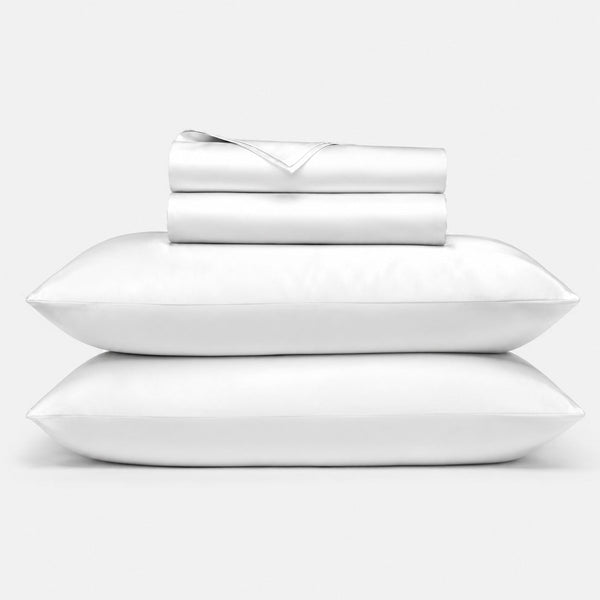
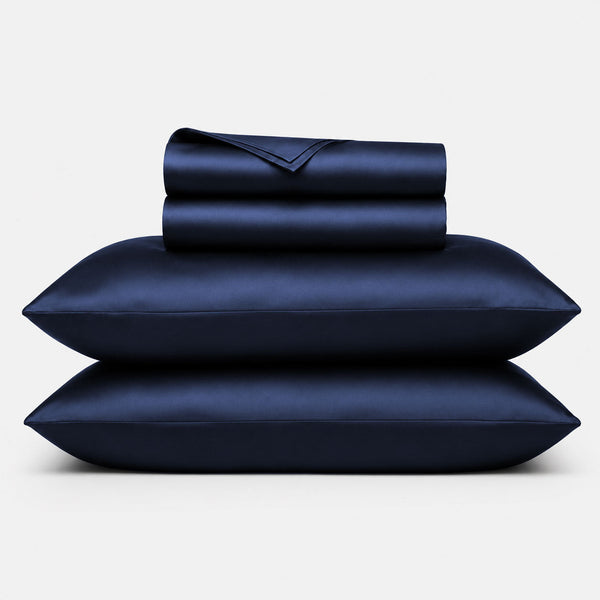
100% rayon (viscose) from bamboo · 17-inch pockets, corner straps · Split Top King $169.95 · free shipping at $75+.
The questions people also ask.
Does sleeping on an incline help with acid reflux?
How much incline is enough for reflux?
Can you just stack more pillows?
The distinction matters because the mechanism is postural. The esophagus has to sit higher than the stomach along your whole upper body, and a pillow cannot arrange that for more than a few minutes of drifting sleep. A wedge or a raised bed holds the geometry all night without your cooperation.
Which side should you sleep on for reflux?
Is sleeping inclined safe for everyone?
The adult and infant questions are entirely different. For adults this is a comfort-and-tolerance conversation to have with a doctor who knows your health history. For babies, the Safe Sleep for Babies Act bans inclined infant sleepers outright — worth knowing if grandchildren visit with their own gear.