You already know the size name. You bought the bed for a reason that had nothing to do with bedding — reflux, or apnea, or a back that stopped tolerating flat, or simply because one of you reads at forty degrees and the other does not. Then the sheets that came with it wore out, or never fit right, and now you are reading reviews of Sleep Number sheets trying to work out whether to buy theirs again. We sell a competing set, so read this knowing that. What follows is what their own site publishes about their sheets today, what ours does, and the one measurement that decides more of this than anything written on either label.
Every Sleep Number sheet set publishes a 15-inch fit ceiling, and the Ultrasoft Knit size chart is lower still at 13 inches — so if you run a mattress pad or a pillowtop on a FlexTop King, depth is the thing to check before fibre or price. Their Lyocell Ultra is a blend (68% lyocell, 27% cotton, 5% elastane in the fitted sheet) at $279.99 for FlexTop King as displayed on 16 August 2026, down from a regular $349.99. Ours is 100% rayon (viscose) from bamboo with 17-inch pockets and corner straps at $169.95 in the same size.
Start with fifteen inches.
Nearly every disappointed sheet review for this bed is a depth problem wearing a fibre problem's clothes. The set feels fine in the hand, goes on tight the first night, and then a week later the top corner has walked off the mattress and you are standing at the foot of the bed at six in the morning deciding whether to blame the sheets or yourself. Almost always the answer is arithmetic. A FlexTop King is 76 by 80 inches of sleeping surface, but the number that matters is the one running vertically, and it is not the number on the mattress box once you have added anything on top of it.
Here is what Sleep Number publishes on its own product pages, checked on 16 August 2026. The consistency is the story: across the whole range, the fit ceiling is the same.
| Sheet set | Published depth | Thread count |
|---|---|---|
| Essential Fit Cotton | 15-inch fitted height | 300, sateen |
| True Temp | Fits mattresses up to 15 inches | 300, sateen |
| Lyocell Ultra | Fits mattresses up to 15 inches | 300, sateen |
| Supima Cotton | Fits mattresses up to 15 inches | 600 |
| Ultrasoft Knit | Details say 15 inches; size chart says 13 | Not stated |
| Overstock Sheet Club 100% bamboo | 17-inch pockets, corner straps | 300, sateen |
Fifteen inches is not a stingy number. For a bare mattress it is plenty, and if you have never added anything to yours you may go a decade without noticing the ceiling exists. The trouble starts with the things people put on a bed they spent five thousand dollars on: a mattress pad adds an inch or two, a protector adds a little, a topper adds considerably more. Measure yours with everything on it, corner to floor-side, before you buy anything. We wrote the tape-measure version of this in our piece on whether regular king sheets work on a FlexTop King, and the method is the same whichever brand you end up choosing.
The Ultrasoft Knit discrepancy is worth naming rather than glossing. Its Details copy says it fits any mattress up to 15 inches; its own size chart gives a 13-inch fitted height on every size, FlexTop King included. Both numbers are theirs. If depth is your deciding factor, use the lower one — a size chart is a manufacturing spec and marketing copy is not.
FlexTop King is the size that quietly disappears.
The second fit problem with this bed is not dimensional, it is availability. Split top king — top split king, flex top king, head split, whatever the maker calls it — is a low-volume size, and low-volume sizes are the first to go out of stock and the last to come back. It is why the size exists on a size chart more often than it exists in a cart.
Sleep Number's own range shows this clearly. Checked on 16 August 2026, four of their six sheet sets offered a FlexTop King you could actually add to a cart: Essential Fit Cotton, Ultrasoft Knit, Lyocell Ultra and Supima Cotton. True Temp — the set with the cooling technology, and the one most of the review sites at the top of this search are actually reviewing — listed FlexTop King as a size but showed it unavailable in all six colours, with the add-to-cart button greyed out. Winter Soft, on clearance, listed FlexTop King in its size chart but did not offer it in the one colour still selling. Stock moves, so this may well have changed by the time you read it; check before you take our word for it.
That gap is worth understanding rather than scoring points off. It means the reviews you are reading and the product you can buy are not necessarily the same product. Sleepopolis, Mattress Nerd, Mattress Clarity and CNET have all tested True Temp; if you own a FlexTop King, you may be reading a very good review of a set that will not currently ship in your size. If terminology is what is tripping you up rather than stock, we have a piece on flex top versus split top that untangles the naming.
The reviews you are reading and the product you can buy in your size are not always the same product.
On checking the FlexTop King option before the star ratingFlexTop King, split king, and the California problem.
Four names sit next to each other in every size dropdown and only one of them is your bed. FlexTop King — what most makers call split top king — is a 76 by 80 inch king that splits only at the head, so the base stays one piece. Split King is two separate Twin XL mattresses side by side and splits the whole way down. FlexTop California King is the same head-split design on the longer, narrower California footprint, and Split California King divides that one fully. A split king fitted sheet will not work on a FlexTop King and a California size will not work on a standard king, and the two mistakes account for a large share of the angry sheet reviews you have been reading.
The California king split sizes are where people get caught most often, because a California king is four inches narrower and four inches longer than a king, and a fitted sheet will very nearly go on before it refuses at the last corner. If you are not certain which of the two your bed is, measure the width before you order anything. We put the full disambiguation in split king versus split top king, which is the piece to read if the queen, king and California king labels have started running together.
Our own bamboo set is made in five: Split Top King, Split King, Queen, King and California King. It is not made in Twin, Twin XL or Full, and we would rather say so plainly than have you find out at checkout.
Depth is half the answer. The other half is what grips.
A sheet stays on an articulating bed through two mechanisms and most sets only use one. The first is elastic — a band around the perimeter, or elastane spun into the fitted sheet itself, which is the design choice Sleep Number has made on both Essential Fit Cotton and Lyocell Ultra with 5% elastane in the fitted piece. That works well on a static mattress. The second is mechanical: corner straps that pass under the mattress and hold the sheet down rather than merely holding it in. On a bed whose head section lifts and drops every night, the difference between those two features shows up within a week, because elastic recovers from stretch a little less each cycle and a strap does not stretch at all.
This is why we build to 17 inches and add corner straps rather than picking one. Deep pockets alone leave slack for the bed to work loose; elastic alone eventually gives. Neither approach is wrong, and a soft, well-made cotton sheet set with good elastic will be perfectly comfortable on a bed that does not move. Ours is designed around the assumption that yours does, every single night, which is a narrower design brief than a company selling sheets for every bed in the catalogue can reasonably adopt.
What these sheets are actually made of.
Fibre comes second, and it comes second on purpose: a sheet in the wrong depth is wrong no matter how it feels. But once fit is settled, composition is where the real difference between these sets sits, and it is more interesting than the marketing on either side suggests. Here is what Sleep Number publishes in its own Fabric and Care copy, verbatim, alongside ours.
| Set | Composition as published |
|---|---|
| Lyocell Ultra | Fitted sheet: 68% lyocell, 27% cotton, 5% elastane. Flat sheet and pillowcases: 70% lyocell, 30% cotton |
| True Temp | 76% cotton, 22% 37.5 polyester, 2% spandex |
| Supima Cotton | 100% Supima extra-long staple cotton, grown in the USA |
| Essential Fit Cotton | Fitted: 95% extra long staple cotton, 5% elastane. Flat and pillowcases: 100% extra-long staple cotton |
| Ultrasoft Knit | 72% Modal, 28% Sorona Elasterell-P |
| Overstock Sheet Club | 100% rayon (viscose) from bamboo |
Two things stand out. The first is that Lyocell Ultra, despite the name, is not a lyocell sheet in the way most people hear that phrase — it is a lyocell-and-cotton blend with elastane in the fitted piece for stretch. That is not a criticism. Elastane in a fitted sheet is a sensible engineering choice, especially on a bed whose head section moves every night, and the cotton content does real work on durability. But if you came looking for a single-fibre sheet, that is not what this is, and the product name does not make that obvious.
The second is Supima. Six hundred thread count in 100% extra-long staple cotton grown in the USA is a genuinely good specification, and it is the one set in their range we would point a cotton person toward without hesitation. It also sits right at the honest ceiling: thread counts above roughly 600 are marketing fiction, produced by counting plied yarns twice, and it is to Sleep Number's credit that their range tops out at 600 rather than advertising a four-figure number the way a great deal of the market still does.
The Sleep Number True Temp sheet set is the only one in the range with a named cooling technology, and it is the set nearly every review at the top of this search is testing. Their page states that active particles in 37.5 technology move heat and humidity away to help you sleep at just the right temperature, and notes that 37.5 is a trademark of Cocona, Inc. That is their claim about their product and we will leave it standing as such. Our own set makes no engineered-particle claim; it is a plain sateen in a single regenerated cellulose fibre, and what that does and does not do for temperature we have written about separately in do bamboo sheets keep you cool, including where the evidence is thinner than the category likes to admit.
What it costs, and what the gap is buying.
Price comes third because it should. You did not buy this bed on price and you are not going to buy sheets on price either. But the numbers are part of an honest comparison, so here they are, all captured from Sleep Number's own product pages on 16 August 2026 with FlexTop King selected. Note that a sitewide sale was running that day, so the regular prices are the fairer long-run anchor.
| Set | FlexTop King, as displayed 16 Aug 2026 |
|---|---|
| Lyocell Ultra | $279.99, regular $349.99 |
| Supima Cotton | $279.99, regular $349.99 |
| Essential Fit Cotton | $259.99 |
| Ultrasoft Knit | $169.99 |
| True Temp | Not displayed — size unavailable in all colours |
| Overstock Sheet Club 100% bamboo | $169.95 |
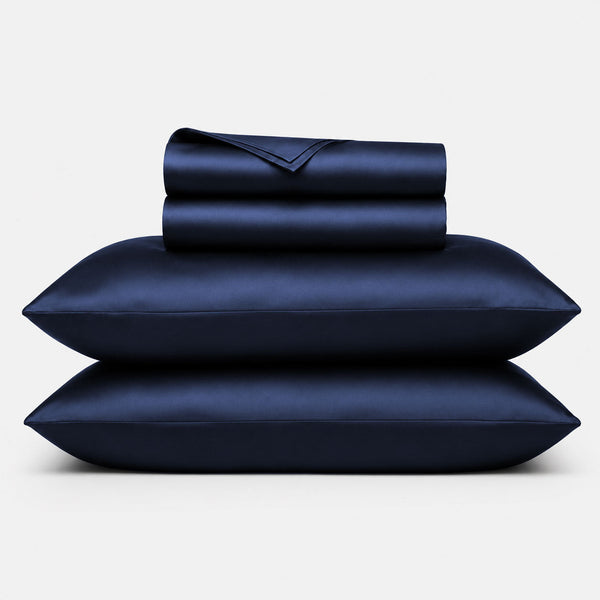
Colour is the other axis worth a sentence, because it is the one thing a split top king buyer reliably changes their mind about. Sleep Number's True Temp sheet set listed six colour options on the day we checked, and their other cotton sheet sets carry their own colour ranges — the Essential Fit Cotton set defaulted to White, Lyocell Ultra to Marine Blue, Supima to Pewter. Ours comes in seven: White, Cream, Silver, Shore, Dune, Sage and Navy. That matters more than it sounds, because the colour option people pick for a second and third set is almost never the one they bought first.
What the gap between roughly $350 and roughly $170 is buying, honestly, is mostly brand, retail footprint and the convenience of ordering bedding on the same account as the bed. Some of it is real: Supima cotton grown in the USA costs more than regenerated cellulose, and that price difference is a material difference, not a markup. Some of it is not. We are a small operation selling one bamboo set in five sizes and we do not carry the cost of showrooms.
The more useful thing we can tell you about spending is not about the first set but the second. In our own order data, 78.5% of split top king buyers take one set and 21.5% take three at once — and of those buying three, 76% choose three different colours. That is Overstock Sheet Club order data, not an industry figure. The people doing it are not stocking up on a deal; they are building a rotation so that nothing has to be washed, dried and back on the bed the same day. On a bed with this many pieces, that is the single change that most reduces the friction of laundry day, whichever brand's sheets you rotate.
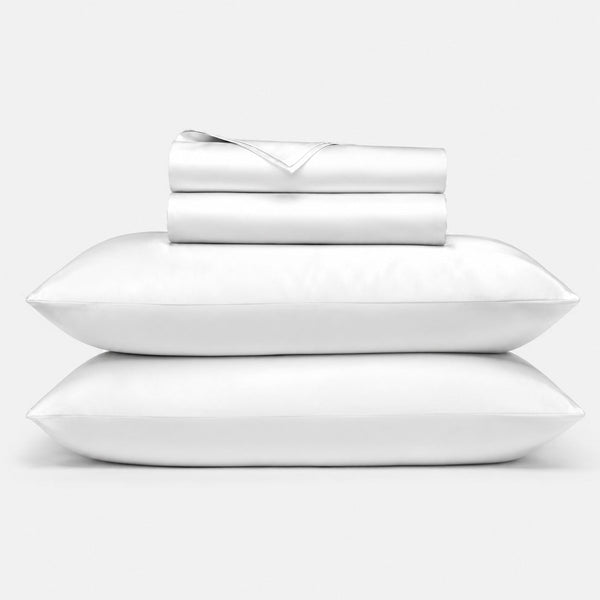
Our set is 100% rayon (viscose) from bamboo in a 300 thread count sateen, with 17-inch pockets and corner straps, in Split Top King at $169.95 across seven colours. Free shipping starts at $75. We sell it, so weigh that accordingly against everything above.
The set built for the 17-inch case
100% rayon (viscose) from bamboo · 17-inch pockets, corner straps · Split Top King $169.95, seven colours.
One last thing, since this audience mostly arrived at an adjustable bed by way of a symptom rather than a preference: nothing about a sheet set treats reflux, apnea or back pain, ours included, and anything you read that implies otherwise is selling. Positioning questions belong with your doctor. Sheets are a fit problem, and that is the whole of what we are claiming here.
Questions owners of this bed actually ask.
Are Sleep Number sheets worth it?
Worth it depends almost entirely on your stack. On a bare mattress their sets fit properly and the construction is sound. Add depth and the same set becomes the wrong purchase, which is how a well-made sheet ends up in a one-star review about corners popping.
What kind of sheets go on a Sleep Number bed?
There is nothing proprietary about the bedding. The bed is a normal 76 by 80 inch king footprint with a head split, so the only requirements are the split and enough pocket depth for your mattress plus whatever you have layered on it.
Is Lyocell Ultra 100% lyocell?
That is taken verbatim from their Fabric and Care copy. It is a reasonable construction for a bed that moves nightly; it is just not what the name implies to most readers.
How deep are Sleep Number sheets?
Measure your own mattress with everything you sleep on already in place, then compare. Two inches sounds like nothing until a pad and a protector have eaten it.
Why is True Temp not available in FlexTop King?
We are reporting only what their page displayed on the day we checked. Split top sizes sell in small numbers and go out of stock more often than common sizes across every brand, ours included.
Do I need three sets of sheets for a split top king?
That is our own order data and should be read as such. Two sets solve most of it; three means a set is always clean, always dry and always folded.